
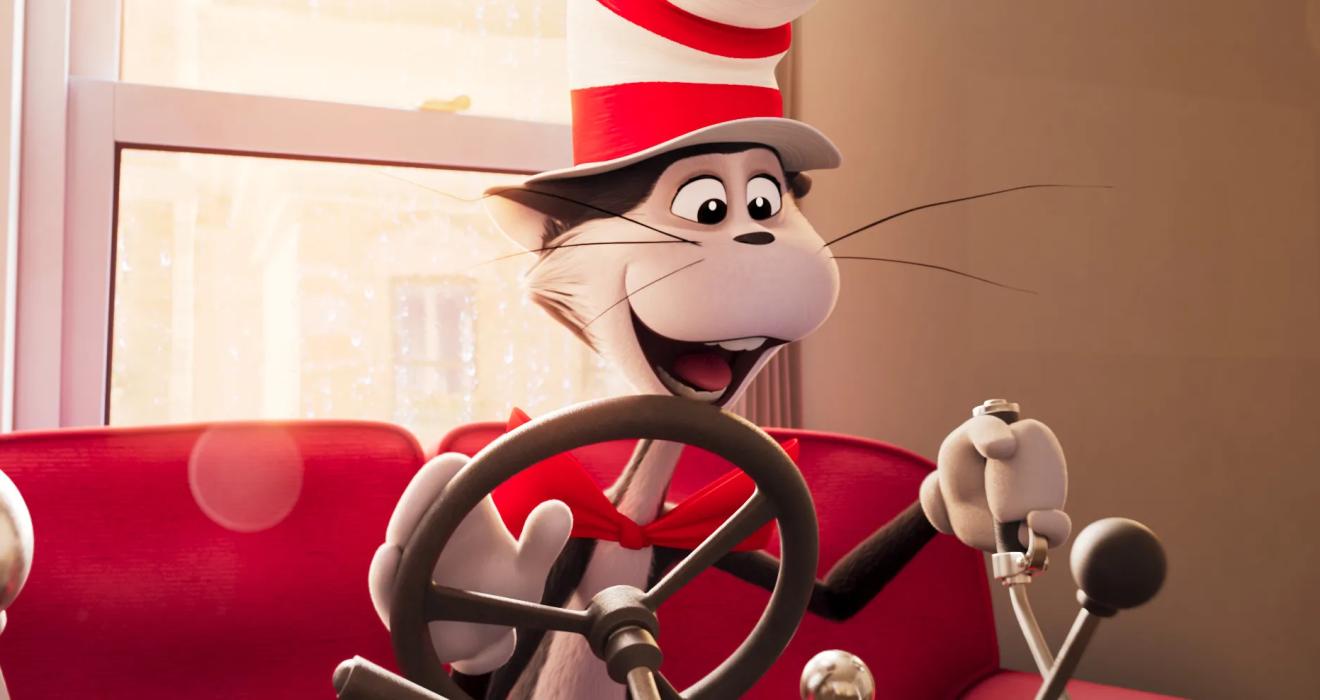
“The Cat in the Hat” (2026) Review
Director: Erica Rivinoja, Alessandro Carloni Screenwriter: Erica Rivinoja, Alessandro Carloni Cast: Bill Hader, Matt Berry, Quinta Brunson, Xochitl Gomez, Giancarlo Esposito, America Ferrera Distributor: Warner Bros. Pictures Running Time: 107 min. MPAA: PG
In 1957’s The Cat in the Hat by Theodor Geisel, the greatest conflict is that the children worry about the mess their mother will see. In the 2026 animated adaptation, the most dire conflict is the end of all existence. Turning a 61-page kids’ book into a feature-length film will require additions, but what’s added here doesn’t warrant lengthening the short tale of the mischievous cat who brings joy to children. The result is a mess of story and tone that is far less funny and way less sunny.
The movie fills in some blanks we didn’t need answered, such as how the cat’s happiness operations work. Instead of his presence being a mystery, the hat-wearing cat (Bill Hader) exists in a Monsters, Inc .-style dimension, where making kids happy is a job of all sorts of odd creatures. The cat is skilled at making kids happy, but not so much at cleaning up his messes, something he apparently has to learn instead of knowing when his playtime has come to an end and requires tidying. He apparently has to earn that wacky cleaning machine, and the cat’s boss, the spiteful Mr. Hoogeboom (Giancarlo Esposito), is hoping he’ll fail his last chance to prove himself. Quinta Brunson, the sympathetic HR director of this silly organization, hopes the cat won’t fumble again.
The cat’s trickiest task is to delight the toughest case of siblings who have moved into a new apartment. The older sister, Gabby (Xochitl Gomez), misses her old home while her younger brother, Sebastian (Tiago Martinez), tries to cheer her up. This family faces familiar and relatable difficulties beyond being bored on a rainy day: Gabby is uncertain about a new environment, Sebastian fears she’ll lose her imagination, and their mother (America Ferrera) is less present and less creative. I was surprised the film never dug that deep into divorce, given how dark it could get at times. With Gabby not so easily amused by the cat’s antics, she does take interest in his dangerous device that can turn back time. Maybe she could turn back time on the clock to when she didn’t have to leave her old room behind.
While these are some heavy emotions to deal with, such a wacky animated film isn’t equipped to dig into them. So the conflict becomes an adventure into imaginative worlds that spell out all the family associations, just in case the younger kids don’t get the symbolism. They won’t have any issue appreciating the silent slapstick of the many Thing characters who litter the screen. But even that silly dose of cartoon clapping and slapping still comes bundled with dark tragedy, as there is one Thing missing who apparently suffered a horrific fate. I started questioning just how dark this film was willing to go when the kid protagonists were pursued throughout this adventure by a monster that looks less like it comes from the pages of Dr. Seuss and more like H.P. Lovecraft.
When the movie isn’t treading into dark territory, as when the children are nearly massacred by a giant paper shredder, the animation can be eye-pleasingly colorful and amusing with its physical antics. But the titular character rarely feels like a force of fun in his own story. I think a big miscalculation was the casting of Bill Hader, coming off more muted than wacky for such a role. Many years ago, Hader played an exaggerated version of The Cat in the Hat on Saturday Night Live, where the joke was that he would break character when confronted by a former lover. That same voice is used for this animated version of the cat, who not only sounds smugly sedated by his energy-demanding career, but also has a history with Gabby’s mom as a former kid client. The script expects the audience not only to feel something for this mostly off-screen relationship, but also to feel sorry for the cat’s inability to clean up his mistakes or recognize his destructive egotism. Posing the cat as needing a lesson initially frames him as a rather mean figure at times, brushing off childhood drawings as awful and getting almost too giddy about burning sentimental items. It also doesn’t help that a running gag is the cat continuously adding lyrics to his own theme song, which wasn’t that catchy to begin with. It’s astonishing how off the central cat feels in a film that features predictable yet suitable casting choices: Matt Berry as the stern fish Waffles, Paula Pell as a nosy landlady, Bowen Yang as an apathetic intern, and Titus Burgess as a sassy singing narwhal.
The choice to frame The Cat in the Hat less as a silly time at home and more as an epic adventure is a rather baffling choice given the plethora of Dr. Seuss books to choose from. Stories like The Butter Battle Book and Yertle the Turtle offer more compelling commentary on the arms race and authoritarianism, which could support more authentic conflict rather than coming off as ill-fitting as it does here. The limitations show in a film that reduces serious subjects to sentimental melodrama and tiresome exposition. I can recall being drawn to The Cat in the Hat at a young age because the book felt more compelling than the other books aimed at first-time readers. This adaptation blends into the sea of other forgettable animated films, and I doubt it’ll be a pleasing experience for first-time moviegoers, with its deeply somber moments, terrifying monster, and the threat of time collapsing.
It doesn’t help that before this film started, there was a hilarious new Looney Tunes short, Daffy Season, in which Daffy tries to convince a soccer-crazed Elmer Fudd to hunt him. It was brief, but clever and amusing, proving that a feature-length adventure isn’t always the best fit for a beloved childhood character. I was far more invested in how the children in the book would clean up their house than in whether or not the kids in the movie could defeat the monster threatening an apocalypse. So, yes, the book was better.