
“Buddy” (2026) Review
Director: Casper Kelly Screenwriter: Casper Kelly, Jamie King Cast: Cristin Milioti, Delaney Quinn, Patton Oswalt, Michael Shannon, Topher Grace, Keegan-Michael Key Distributor: Roadside Attractions Running Time: R
The fossilized footprint of Barney the Dinosaur was so ubiquitous in the 1990s that it’s hard to explain his fluffy grip on the youth and the toxic level of hatred towards the TV show’s character. His presence can best be summed up by Gene Siskel covering one of Barney’s VHS tapes on the Siskel & Ebert Holiday Gift Guide. When Gene, a father with children who watched this show, brought up how people love Barney, Roger Ebert responded, “I don’t love Barney. Maybe if I got to know him, I might like Barney.” Barney’s declaration of how others love him was something we all thought about and scrutinized to death. It becomes a fascinating starting point for Buddy, a surreal horror that explores the darkness of love demanded rather than earned.
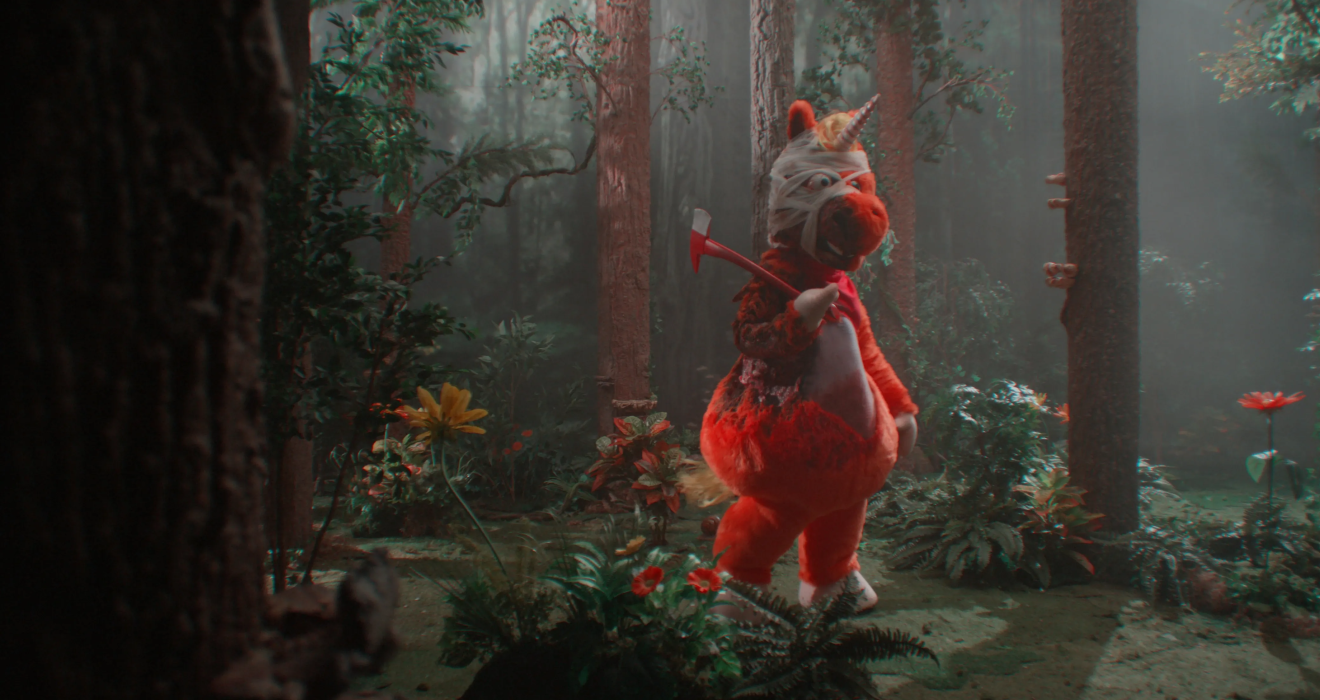
Director Casper Kelly is no stranger to this level of retro terror, having worked on the iconic Adult Swim short Too Many Cooks, in which a never-ending TV sitcom intro turns into a horrific experience. Similarly, this movie starts with an era-accurate replication of Barney, with the titular orange unicorn teaching kids lessons, voiced impeccably by Keegan-Michael Key. Everything is wholesome and fun until one of the kids becomes disinclined toward the day’s lesson. An absence concerns Freddy (Delaney Quinn), who notices that child actors have been replaced and that anthropomorphic characters have been damaged. The creeping fear of being trapped in a TV show with forced consent to Buddy’s love soon turns this lightly colored show into a violent nightmare, splattered with more guts than fluff.
I had a different fear about Kelly’s film: that it would exhaust its horror concept by relying on retro allure. The opening staging of an astute 90s kids show is so on point that a lesser director would’ve rested on that simplistic concept. But unlike Kelly’s less thoughtful gore fest that was the Fun Size segment from V/H/S/Halloween, this movie manages to be more than a series of grotesque murders committed by a cuddly character (but, holy shit, does it ever get gory).
Buddy’s very existence depends on manipulating the audience, preying on their isolation and despair to make Buddy’s love seem so tantalizing. The lure of Buddy becomes a manipulative force that, by the time one discovers his sinister intent, it’s too late. You’re already bound to a world where even the squeaky-voiced Betty Bunny (Jimmica Collins) and helpful talking backpack Strappy (Patton Oswalt) live in fear of what happens when kids don’t love Buddy. And while the movie does reveal some of the layers that spawned this unicorn’s insidious TV magic, there’s never a fully grounded explanation for why this is happening to poor Freddy and her fleeing TV friends. There’s a far bigger apparatus that has constructed somebody like Buddy, and sometimes all you can do is just find a way out rather than burn that system to the ground. It’s far easier to target Buddy when it becomes clear that if it bleeds, you can kill it. It’s Predator if the alien were Barney.
The distortion of memory also becomes a key factor in how Buddy functions. This avenue is explored with a more psychological angle in Grace (Cristin Milioti), a mother of one of Buddy’s child actors who has completely forgotten her daughter’s existence. The power of a TV icon is so strong that it can manipulate our own reality, spilling that manufactured set of simplicity into the living room with uncomfortable and unseen byproducts. There’s a desperation in the way Grace struggles to recall what was taken from her, and in how she becomes just as much a victim as her daughter for daring to question a children’s show. The adults who presented Buddy as a babysitter take little notice of where Buddy’s words will guide them, refusing to see what lies beneath the fluff of silly voices and songs.
The exploration of this idea becomes fascinating for how daring Kelly is in probing the darker corners rather than coating the brighter spots with a bucket of blood. There’s a strange thrill in watching the escaping child actor discover a weird world of discarded TV characters, limited resources, and drugs most trippy. Through it all, there’s a darkly comedic current that laces this nightmare of gutted children, brutalized puppets, and a diced-up unicorn more bone and muscle than wire and padding. The laughs come at the perfect moments that break the tension, when all the TV-Y dialogue is cut, when murder is on the broadcast. The freedom is unleashed as characters spit out words like “penis” and “bitch” to remind them of what the world is like rather than the uncomfortably padded one being passed as the only avenue for love.
There’s no doubt been a thirst for this type of nostalgic, media-obsessed horror that has risen in recent years, spanning from the creepy anthology Channel Zero to the elaborate satire of Don’t Hug Me I’m Scared. For as much nostalgic allure as this format can present to cathartically satiate a generation raised on pastels and puppets, Buddy charges onward into the inkier depths of that world, able to carry an absurd tune all the way down. One of Buddy’s most notable lessons in the in-universe show is that being afraid is an essential starting point for being brave. There’s certainly a heaping helping of bravery in making a movie this bonkers and brutal, miraculously tying it all together into something as frighteningly gruesome as it is outrageously ridiculous.


