
“Dolly” (2026) Review
Director: Rod Blackhurst Screenwriter: Rod Blackhurst, Brandon Weavil Cast: Fabianne Therese, Russ Tiller, Kate Cobb, Eve Blackhurst, Michalina Scorzelli, Ethan Suplee, Seann William Scott, Max the Impaler Distributor: Shudder Running Time: 83 min. MPAA: R
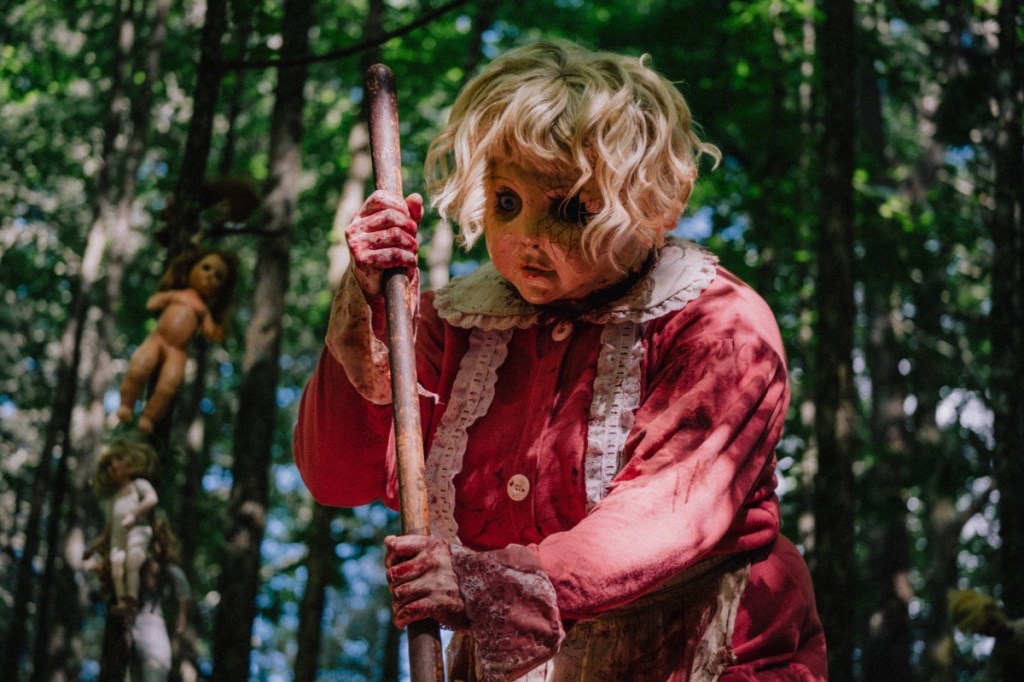
The masked killer of Dolly feels familiar yet unique. The premise of a killer adorned in a giant doll head, dress, and a desire to play house is a recipe for some disturbing and intense horror. There does seem to be an aim for that retro horror, as director Rod Blackhurst favors a grindhouse shooting style and progression of the terror. His favoring of breaking chapters, however, reveals a story more diced up into digestible chunks when this is the type of slasher you want to ingest whole.
Part of me wishes this were more of an anthology entry in the V/H/S/ horror franchise, even though the movie itself is based on Rod’s own short film. The appeal seems more about the improved effects and gore than about placing a more compelling story atop the tasty dollops of brutality. Consider the ordeal for the targeted couple, Macy (Fabianne Therese) and Chase (Seann William Scott), as their relationship nears marriage. Macy’s doubts concern Chase having a daughter and whether she wants to take on the duties of motherhood. There’s a reason to root for Macy’s survival to both marry the man she loves and step up to a new role as a mother.
That fear of motherhood and of handling children would be the perfect jumping-off point when Macy encounters the murderous Dolly (Max the Impaler). Isolated in the woods, the silent figure has the look of a doll with her big dress and porcelain head, creepy enough before she even starts her violent acts. Her whole deal isn’t that hard to figure out: Dolly wants to play house and views Macy as the latest baby in her collection of people who are now playthings. Thus, Dolly proceeds to spank, feed, and nurse her new child in a manner that is as grotesque as one might expect for a horror film such as this.
Like a costume drama, heavier on detail than story, Dolly is most enjoyable when taking in the disgust at the gore and the staging of a house of horrors. The film has an intoxicating quality when watching Dolly force open somebody’s jaw with a shovel or whip out a breast to feed her latest victim. However, while appreciating the details that went into this filthy setting, my mind drew back to the most recent comparison of the short “Coochie Coochie Coo” from V/H/S/Halloween, where a monstrous woman trapped victims in her spooky house, not to kill them, but turn them into her permanent children. That short still struck me as unique for being genuinely disturbing and clever in its revelations. By comparison, Dolly feels a little too standard, even with the devotion to stage a gritty and gross horror as could be mustered from this premise.
As much as I adored the situations, I still felt as though the film could go a little further and be a little more vile. Macy’s development doesn’t really extend beyond adhering to Dolly’s rules, and it feels like a wasted opportunity to say something a little more about motherhood. The effects are sufficient in scenes of Dolly delivering various tortures, but the killing moves of holes through torsos and decaptiations reveals too much of the limitations, given the usage of CGI and forcing the camera a little too close to the more practical effects. Given what happens to Macy and Chase in this movie, I expected a little more from a film that seems to shelve its thematic development for a my-size dollhouse of horrors.
Dolly has some dark appeal on the surface, but nothing much more beyond its gritty porcelain facade. I had some fun once the film settled on being little more than a tale of one doll-dressed figure torturing the unfortunate hikers who tread her path, but more for the intensity of Macy’s survival than any connection she has with being a parent. It’s a film that I enjoyed in its bloody bits and pieces, and there’s clearly a cleverness present that doesn’t feel as evoked. Consider the credits, which boast a Non-Thanks to the mosquitoes during filming and the closing song, which references that Dolly character as “having a bee in her bonnet.” That’s the type of odd amusement that feels like it’s struggling to burst in this movie, but can’t quite puncture that sturdy doll surface.
