
“Little Amélie or the Character of Rain” Review
Director: Maïlys Vallade, Liane-Cho Han Screenwriter: Liane-Cho Han, Aude Py, Maïlys Vallade, Eddine Noël Cast: Loïse Charpentier, Victoria Grosbois Distributor: GKIDS Running Time: 77 min. MPAA: PG
Amélie Nothomb’s true story as a Belgian girl growing up in Japan is seen as a perspective between worlds that extends beyond the cultural. Wielded with the whimsy of animation, Little Amélie succeeds in becoming a more earnest coming-of-age tale than an unorthodox one. It’d be so easy for this type of film to stew in the saccharine innocence of childhood, but directors Maïlys Vallade and Liane-Cho Han remarkably find a way to make the young Amélie’s (Loïse Charpentier) formative years an equal mixture of maturity and heart.
The youthful Belgian girl in a Japanese land gets to narrate her own story, viewing herself as a god who makes her own decisions. She decides when the right time is to walk and talk, mainly remaining silent among her family and divinely eloquent in her introspection. There’s an amusement in Amélie’s viewing herself this way, but also an honesty that sidesteps the phony way adults view children. It’s refreshing that Amélie’s internal dialogue stresses an agency of feelings that are more genuine than foreign. For her, eating Belgian chocolate for the first time is not just a tasty treat; it’s next-level transcendence.
With her father constantly working, her mom overworked, and her siblings annoying, Amélie favors a friendship with her nanny, the kind-hearted Nishio-san (Victoria Grosbois). A bond is built on a foundation of Japanese fascination and honesty, as Nishio will teach Amélie everything, from Japanese folklore to writing in Japanese. Of course, a curious Amélie will ask about far more than the basics, as when a death in her family prompts her to ask about Nishio’s similar experiences. Nothing is softened for Amélie in these conversations, as Nishio openly speaks of how war took her family from her. The lingering wounds of the war also coat much of Nishio’s plight, as the harsh landlady Kashima (Yumi Fujimori) still harbors bigotry towards association with foreigners, a hideous side of humanity that Amélie struggles to grapple with.
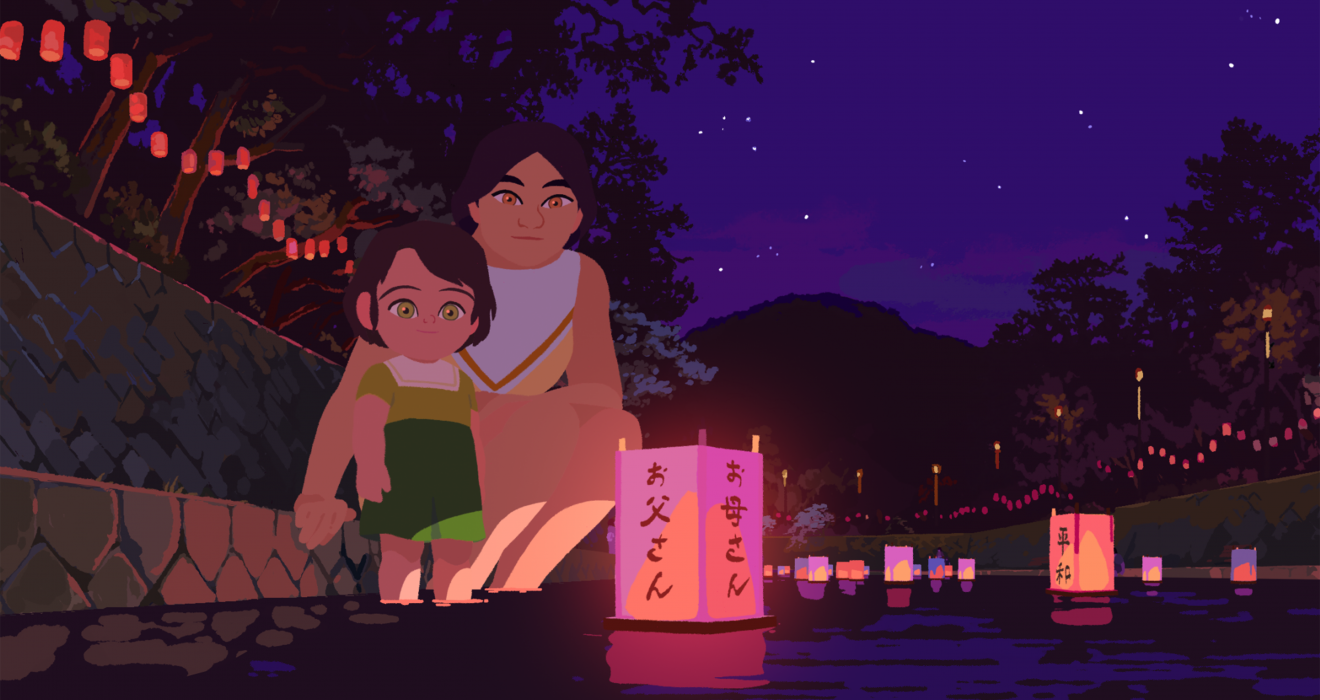
The lush 2D animation works well for this type of story, dipping between Amélie’s wondrous fantasies of god-like existence and the beautiful realism of 1960s Japan. Though visually distinct from the works of Hayao Miyazaki, the film shares a similar sentiment, focusing its fantasy on the bluntness of youthful perspective. Amélie notices how the world is unfair through the celebration of men, finding comfort in her connection with Nishio over koi that look as ugly as boys. When Nishio can’t be with Amélie anymore, there’s a heartbreak where it feels like only death will provide comfort. When the world is seen through such small eyes, even the most minor tragedy can be the most catastrophic, and the film never tries to minimize these concerns.
For a story told from a child’s perspective, Little Amélie is surprisingly mature and never reduces its heart and heartbreak to whimsical melodrama. I like to think of this film as the charming offspring of My Neighbor Totoro and Grave of the Fireflies for its earnest merging of childhood innocence and somber grief. The animation is absolutely gorgeous, and the introspective Amelie is effortlessly cute as she tries to understand the world. Children tend to see the world through different eyes, where adults seem like looming titans that can do no wrong and will never depart. Recognizing that mortality is not easy but an essential part of Amelie’s growth from an all-knowing god to a curious human. Having kids come to that decision on their own makes this sweet film as introspectively mature as it is visually gorgeous.