
“Marty Supreme” Review
Director: Josh Safdie Screenwriter: Josh Safdie, Ronald Bronstein Cast: Timothée Chalamet, Gwyneth Paltrow, Odessa A'zion, Kevin O'Leary, Tyler Okonma, Abel Ferrara, Fran Drescher Distributor: A24 Running Time: 150 min. MPAA: R
Marty Supreme is another gritty tale of a messy loser from director Josh Safdie, but of a much different flavor. Whereas Uncut Gems was all about a man who is one bad bet away from losing everything, Marty steps over everybody and everything to become a winner, not merely because he has to, but because he can. This guy knows he’s in the fuck-around phase and that he’s young and clever enough that the find-out phase is so far out he can’t even see it.
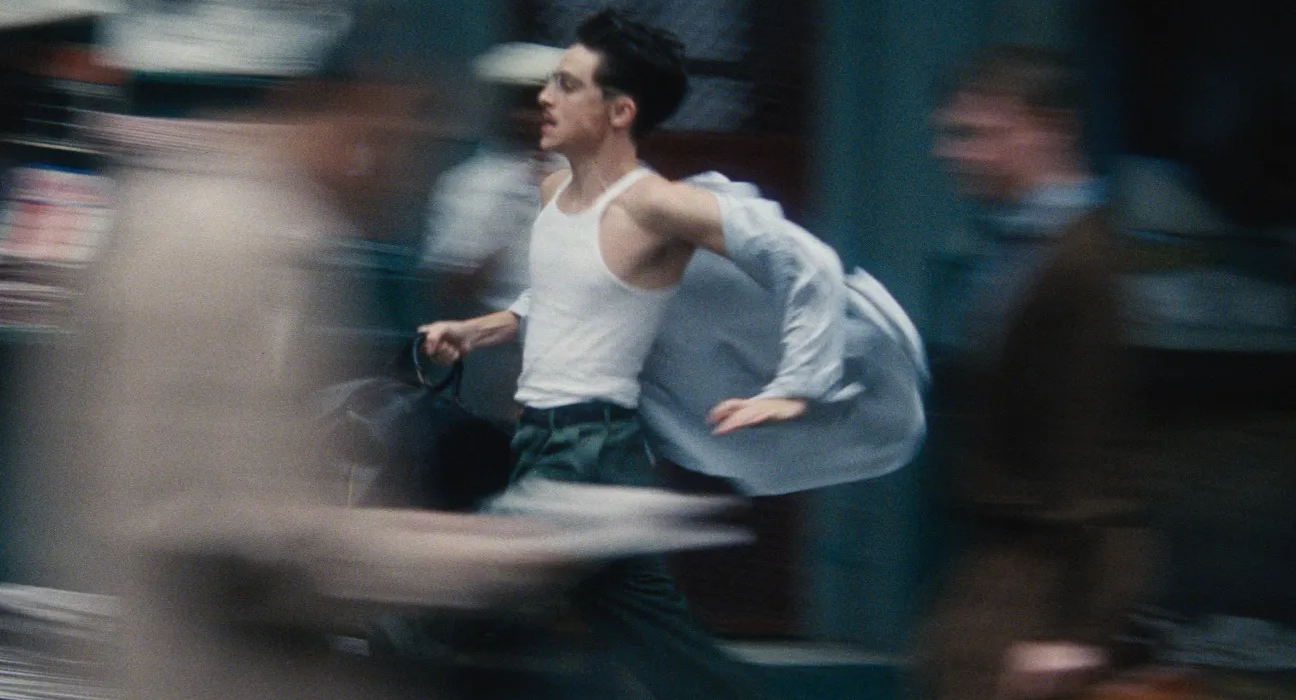
Timothée Chalamet is perfectly cast as Marty Mauser, melting into a loud, dirtbag of a man that is a refreshing change of pace from his quieter brooding in A Complete Unknown. Even with his big glasses and thin mustache that scream scam artist, there is an unstoppable confidence that still oozes through his sweaty fury for getting what he wants. Marty is a skilled ping pong player, but it’s not exactly a lucrative profession unless you’re willing to break some rules away from the table. And even then, it might only get you so far that you’ll still be forced to such humility as playing ping pong with a seal.
Marty’s knack for talking himself up works well enough for money and sex. The married Rachel (Odessa A’zion) is so attracted to a man far more dangerous and alive than her dull husband, Ira (Emory Cohen). It’s not the only time he’ll cuckold as he manages to seduce the retired actress Kay (Gwyneth Paltrow) and negotiate a deal with her wealthy husband, Milton (Kevin O’Leary). They’re all initially blinded by Marty’s rip-roaring nature to notice that he’s a ping pong player with an ego so massive that he makes antisemitic insults towards his opponents and will bark that it’s okay for him to make those jokes as he’s Jewish. Can he make that joke? It doesn’t matter to Marty; everything is acceptable for getting ahead, no matter how much you have to kick up a fuss, commit some crimes, or nearly kill somebody.
There’s a rage that bubbles in Marty where it seems like only the most ambitious and dangerous risk-takers can be on his level and not dump him when the jig is up. Somebody like the hustling taxi driver Wally (Tyler Okonma) is crafty enough to be called Marty’s friend, but someone as violent as the criminal Ezra (Abel Ferrara) is about as safe to be around as a lit stick of dynamite. Folks like these are the type of people Marty would ride with as they teeter over a cliff for schemes so wild that violence follows in the form of exploding gas stations and shootouts. With so much going awry for Marty, there’s a mild relief in the sweaty exhaustion that he can sometimes find a line, even if he has to accidentally hit that wall so hard he apologizes more for the impact than the momentum. He’s somewhat aware of his limitations, given how he loses his big match in Japan, but can successfully argue for a room at the Ritz, something he feels entitled to.
For a film set in the 1950s and semi-biographical, Josh Safdie takes a sledgehammer to historical authenticity, resulting in a perpetually unpredictable film. This is most evident in the soundtrack, which favors music by Tears for Fears and Peter Gabriel. Not era appropriate? Who cares! It works unbelievably well, and Marty’s mile-a-minute battles of the ping-pong and verbal variety are so gripping that they leave little room to question the finer details. Even the score by Daniel Lopatin (Uncut Gems) obliterates convention with a favoring of electronica to match the thematic fury of Marty’s drive. In the same way that the Reznor/Ross score for Challengers felt like another lover entering the love triangle, Lopatin’s music feels like a coach in Marty’s corner, whispering in his ear that he’s one win away from success.
If anything, the more modern winks reveal how out of place Marty seems for being born too soon. He can barely scrape by at times with his drive to become a ping pong champ, but that hustle could’ve easily made him a greedy yuppie of the 1980s or an obnoxious influencer of the 21st century. It’s too bad he’s stuck in the ’50s, where cuckolding husbands, shaking down people who owe you money, and negotiating business deals takes far more physicality. Maybe that’s a good thing, especially for how Marty never fully gets his comeuppance by the film’s end. He survives all his messes, but you know it won’t last forever, and he knows it as well.
Marty Supreme is a potent portrayal of an unhinged prodigy that is dizzyingly thrilling for a movie about a ping pong egotist. Timothée Chalamet is at his maniacal best in a role that offers him a huge challenge beyond perfectly playing ping pong (which he does). Safdie’s direction is mesmerizingly chaotic, from the gritty exchanges to the surreal transitions from a sperm-infused egg to a ping pong ball. There’s a massively impressive cast assembled here (including Fran Drescher, David Mamet, and Penn Jillette) as well as an intoxicating cinematography by Darius Khondji that makes New York as alive as last year’s Anora. But the glue that holds it all together is the fascinating character study of a man who can talk as fast as he plays table tennis. He’s a spiraling mess and a loser at heart, but a loser far too busy getting to the subsequent victory to notice the cracks he’s forming. Somewhere in Marty’s constantly-moving mind is a fear of failure, but he can ignore such doubt. He’s lucky and manipulative enough only to see his entitlement, making him as intriguing as he is slimy. Maybe he’ll fall later in life, but for now, he’s a sleazy schemer with a ping pong paddle, and one you can’t help but gawk at in amazement with his narrow-focused victories moment to moment.