
“Michael” (2026) Review
Director: Antoine Fuqua Screenwriter: John Logan Cast: Jaafar Jackson, Nia Long, Laura Harrier, Juliano Krue Valdi, Miles Teller, Colman Domingo Distributor: Lionsgate Films Running Time: 127 min. MPAA: PG-13
The music of Michael Jackson has always felt like a constant force in pop music that hasn’t diminished since the 1980s. Amid all the controversies and scandals associated with Michael, his catchy, flashy music still permeates pop culture. Antoine Fuqua’s Michael is more interested in marveling at the majesty of this musical legend than in delving deeper into the story of damaged adolescence. Although such a flowery depiction rarely rises above the musical biopic playbook, a spell is cast that can’t be shaken, and it’s hard not to resist the temptation as this picture mutates into the concert-tribute picture I wish it were.
Running at a little over two hours, three decades’ worth of Jackson’s career are covered in a blaze of montages and bullet points. We watch as a young Michael (Juliano Krue Valdi) showcases his stellar voice, making it clear this kid is bound for more than his family ensemble. Beating that pursuit of fame into him is his bitter father Joe, played up with a fine mixture of bewilderment and resentment by Colman Domingo. While the film skips across many players and events in Michael’s rise to fame, the constant thread is a childhood robbed and an inability to escape a family that has wronged him, with the stopping point being Michael taking control of his solo career.
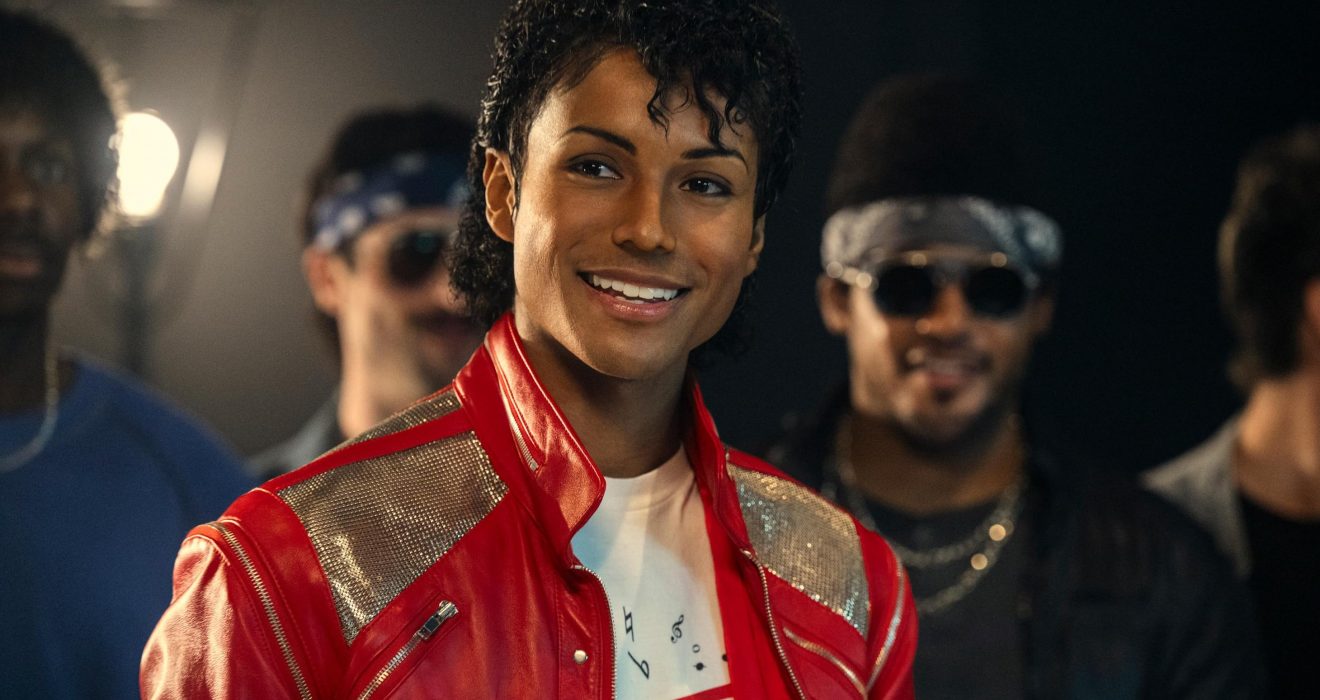
Jaafar Jackson’s performance as adult Michael Jackson is naturally the biggest draw, and it’s easily the movie’s biggest strength. Where the film shines is in watching Jaafar cavort across the screen with his song and dance, shot and edited in a format more concert than cinematic. Much like Michael’s ethos, it’s a gift that Fuqua wants to share, but it is relegated to a picture that seems distant from tackling Michael’s greater struggles. The conflict Michael has with Joe remains present yet silent, where there’s a standoffish quality to how hesitant Michael is to step away from his abusive father. While this does present a believable caution in that confrontation, there are some darker thoughts that seem unexplored.
The heavy focus on Michael’s drive for music overshadows nearly every critical aspect of his life, from his siblings, who are shoved aside, to his exotic animal cohorts, who serve more as punchlines for playfulness. There’s an unwillingness to gravitate towards an uncomfortable level of stunted growth, as Michael’s obsession with toys and children becomes more of a quirk than a concerning byproduct of a rocky home life. You can hear the mechanisms of the locks closing as the protective Jackson estate ensures Michael’s legacy will be more noteworthy as the king of pop than a flawed man sculpted by a terrible dad. The film might not excuse what followed with Jackson’s predatory nature of the 1990s, but it won’t tread into that territory either, for better or worse.
And yet, I find myself returning to the musical sequences that are genuinely thrilling. Even amid all the mythical glaze, there’s a charm that can’t be shaken from the music, a quandary that likely still arises whenever Jackson’s music graces the radio. Recently, I rewatched the Rambo movies, and while their political philosophy is deeply flawed, the action was exciting; I couldn’t deny it. This is not to say that musical biopics are excused from addressing the darker corners, given that there’s plenty of hideousness to explore in Michael’s history. But for a film that is style over substance, Jaafar Jackson’s musical tribute works so well that it’s enough to make one wish the whole film were a concert instead of a by-the-numbers script.
Michael is a bedazzled musical biopic that shines with spectacle, even when knowing full well what lies beneath the sparkly glove. Aside from Jaafar’s performance, the best that can be said of this film is that it mostly succeeds in capturing the vibe of Michael’s appeal, though it’s not the toughest feat for his music, which fits slick montages. It’d be easy for a generation that never grew up with Jackson to look at his controversial history and wonder how anybody could like him. This film attempts to divulge the intoxicating nature of Jackson’s music that slathered the 1980s with so much sparkle, too bright to see darkness, and too dazzled to touch the scandalous. In a way, that feels very fitting for Michael Jackson himself, singing loud enough to keep the horrors at bay for one more performance, with more thought put into how Jackson filmed Thriller than into how he interacted with his siblings. In the picture’s scattershot method of covering the greatest hits, there’s a guilty pleasure in the glimmers and jolts of artistic vibrance that gleam through a highly protective figure. His music remains profound, but his story is still tightly contained, contrary to the closing credits, which suggest it will continue.