
“No Other Choice” Review
Director: Park Chan-wook Screenwriter: Park Chan-wook, Lee Kyoung-mi, Don McKellar, Lee Ja-hye Cast: Lee Byung-hun, Son Ye-jin, Park Hee-soon, Lee Sung-min, Yeom Hye-ran, Cha Seung-won Distributor: Neon Running Time: 139 min. MPAA: R
Capitalist satire often highlights the desperation of the poor amid the arrogance of the rich, as seen in Bong Joon-ho’s Parasite. But the comfy middle class might scoff at the scheming of that picture, remarking that they’ll never end up like that because they work hard and play by the rules. No Other Choice is a film that showcases someone who does all that and still finds himself driven to murder for preservation when the well of work is running dry.
Yoo Man-su (Lee Byung-hun) would seem to have a safe life for being an award-winning employee of the paper industry. He lives a happy life with his family (having purchased his childhood home no less) and is knowledgeable enough about paper that he’s far from falling behind on industry developments. But then it all comes crashing down when Americans buy his company and wipe the slate of every worker. A concerned Man-su tells himself and his family that this is only temporary. After all, he’s a model employee, adept in the art of paper production, and has attained accolades. How hard could it be?
It is very hard, as it turns out. The job market is so tight that other employees are fighting for similar positions with fewer slots. Violence becomes an option when the thought crosses Man-su’s mind to literally kill off the competition, but that path never becomes so simple that this type of story could stumble into becoming a dark comedy of murder for the sake of employment. All of the anxieties of losing everything cloud Man-su’s mind from the moment he is dismissed. One of his first moves after being terminated is attending an unemployment class, where he participates in exercises that stress that it’s not your fault that you were fired. While that statement is true, it doesn’t take away the sting and the inadequacy that come with losing a job.
Akin to Park Chan-wook’s previous pictures, Man-su’s struggle is a complex one that never makes him entirely sympathetic for losing his job or satirical for being middle-class. He’s not that laughable, considering the drive to give his mute daughter Ri-one a chance to excel at music and maybe come out of her shell. There’s also some heartbreak felt that a man who spent his career trying to reattain his childhood home has to lose it again. While that ordeal might not be as relatable, similar sensations of retreating to booze and messing up interviews make Man-su more human than absurd. During one interview, he’s asked the dreaded question every applicant fears: What is your greatest weakness? Man-su mostly refuses to answer the question. Why should he? You can’t show weakness when it comes to getting a job.
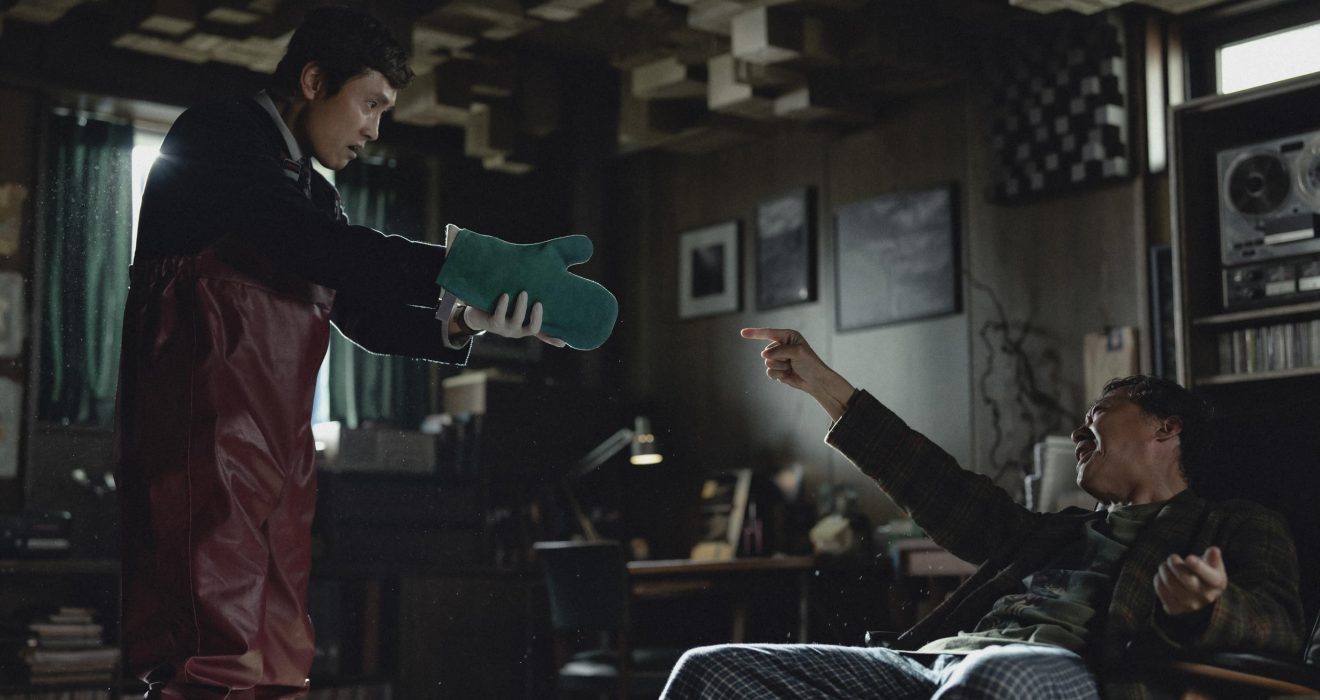
As the violent thriller angle takes over in the second act, it’s a messy ordeal of espionage, blackmail, and murder that goes awry. His most compelling target is Goo Beom-mo (Lee Sung-min), an unemployed drunk whose bitter wife Lee A-ra (Yeom Hye-ran) starts having an affair amid dissatisfaction. Instead of viewing Beom-mo’s lesser lifestyle as something to spare, Man-su can only see it as a warning. What if his wife, Lee Mi-ri (Son Ye-jin), is cheating on him with that handsome dentist she works with, Oh Jin-ho (Yoo Yeon-seok)? Maybe he’ll confront her about this and nip it in the bud. Or he’ll make an ass out of himself. Much like his paranoia, Man-su’s descent into murder is equally sloppy, especially for his methods of gunshots and suffocation. There is always that doubt before pulling the trigger, even if he eventually gets to the point of disposing of bodies.
No Other Choice proves once more that nobody can craft compelling, poignant, and cathartic thrillers quite like Park Chan-wook. While not as darkly cerebral as his past films, it does carry a heavier dose of humanity as it explores a lesser-examined corner of the class struggle when the waters rise to the level of the upper-middle class. The ending also feels so perfect, as Man-su’s struggle prevents him from drowning, but doesn’t offer any comfort for the small raft he’s been granted. The diligence of work means little when money is all that matters, and you can be easily replaced, no matter how many awards you win. Man-su is merely one of many in the middle class who will have to learn this terrible lesson the hard way.