
“Pressure” (2026) Review
Director: Anthony Maras Screenwriter: David Haig, Anthony Maras Cast: Andrew Scott, Brendan Fraser, Kerry Condon, Chris Messina, Damian Lewis Distributor: Focus Features Running Time: 100 min. MPAA: PG-13
One of the most important lines in the historical drama of Pressure is that we must face facts, no matter how frightening they may be. One could add to that line, “no matter the lack of frills,” given how straightforward this movie becomes. Adapted from a stage play, the film never loses focus on the weather on D-Day and on debating the best time to deploy troops amid a storm. That restricted nature keeps this film on track to make the drama more grounded than theatrical, despite the urge to flip over the desks where many heated arguments take place.
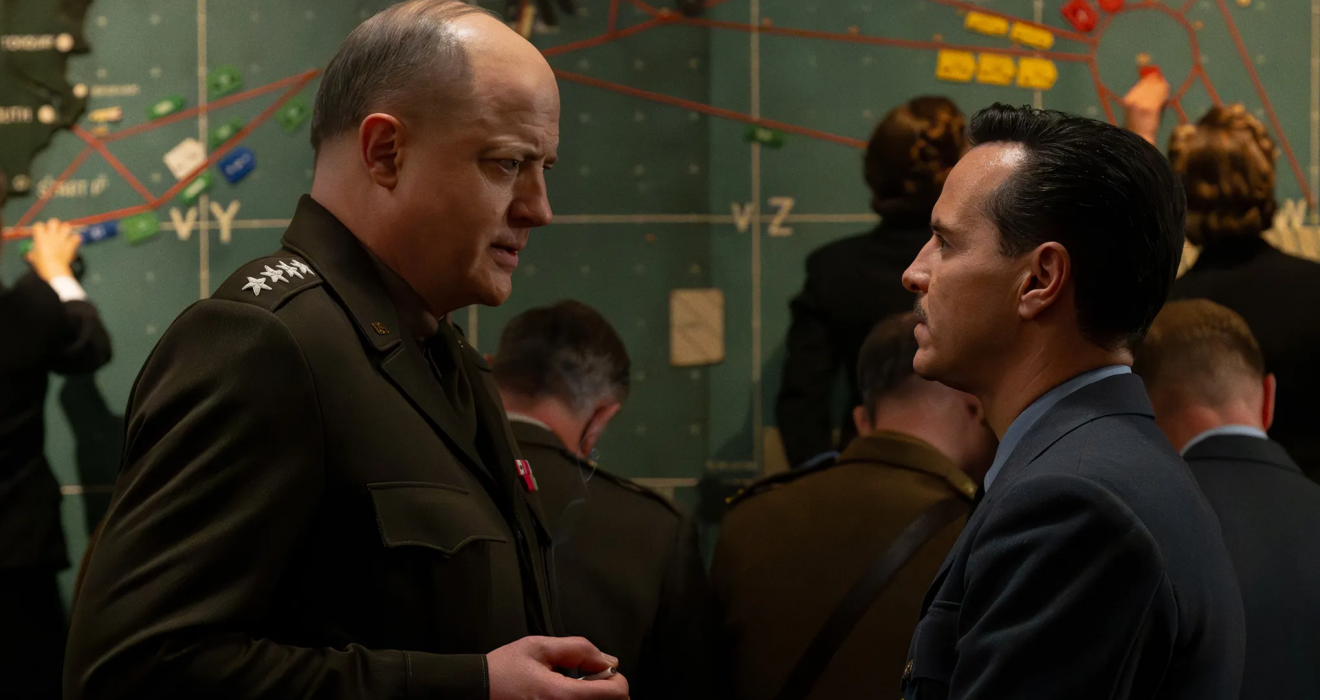
Although the film is built on urgency, there’s a powerful sense of control in how Andrew Scott steps into the role of Captain James Martin Stagg. As a leading meteorologist, he’s called upon to figure out the D-Day forecast with a deadline more in hours than days. This task is impossible to complete without some doubt and uncertainty, but Stagg doesn’t turn down the challenge. Countering his claims of a storm on the way is the hotshot meteorologist Irving P. Krick (Chris Messina), keen to name-drop his celebrity clients. Even more aggressive than Krick’s refusal to budge on sunny weather is the fuming fury of General Dwight D. Eisenhower, played with towering stature and blaring voice from Brendan Fraser. If Scott’s performance was a nuanced display of concentrated intelligence, Fraser is a hurricane of acting that explodes into every room, especially when Stagg corrects Eisenhower on the definition of a hurricane.
There are areas where this film thankfully expands to make a theatrical movie adaptation worth the leap off the stage. Scenes of the dead bodies that followed the Exercise Tiger are portrayed washing up on shore in waves of red. The storm that rolls in has a powerful effect as Stagg takes comfort in his predictions being correct. There are a handful of shots that stress the violence of D-Day so that the climax involves more than men and women crowding around radios, listening closely to whether or not Normandy was successfully taken. But even with these grand displays, the story never veers off track to get lost in the spectacle of weather or the grit of war. Even the addition of Stagg’s pregnant wife is only given enough room to make his motivations more personal, fearing that he’ll lose her in the next bombing.
The clash between meteorologists and the military is a compelling battle, as science struggles to make its case amid those more focused on deployment. There are so many moments where you want to see Stagg lose his calm, grab Eisenhower by his uniform, and spit the importance of weather into his face to illustrate how precipitation works. Stagg instead displays an admirable patience in trying to explain more through thoughtful words about the importance of science. Trying to keep that bridge sturdy is Eisenhower’s secretary, Kay Summersby (Kerry Condon), who is doing her best to ensure Stagg will be in better communication with the important General. She knows that Eisenhower is more terrified in private and that Stagg isn’t just a cold machine that can never generate a 100% chance of rain, and she does her best to ensure these two men recognize their shortcomings so they can make the right call.
As with many films centering around a profession, there’s a tactile quality to this picture, loaded with montages of weather balloons ascending, calls being made, and charts being analyzed. Though expected, the energy of these lets-get-to-work scenes holds a more appealing motivation. Stagg and his men are not just assembling a forecast, but building a bridge between their scientific know-how and the crucial military decisions that could cost lives. It’s thrilling to watch Stagg and Eisenhower attempt to see eye to eye without reducing the scientist to a snide expert and the General to a blustering blowhard. Even someone as brash as Krick isn’t portrayed as a cartoonishly evil opposition, as he genuinely believes in his data and forecast, where Stagg still needs him even after being proven wrong. Maybe it’s just the fatigue of the current Trump administration opposing science at a hideous level of ignorance, but witnessing men in positions of power trying to do the right thing and translate their expertise to one another felt inspiring, even knowing how D-Day plays out.
Armed with an astute mind and a beating heart, Pressure is an exciting tale of weather and war without much fluff. Presented at a relatively brisk 100 minutes, there’s rarely a moment that feels like it’s dragging its heels, even when going through the expected procedures and emotional hallmarks of a historical drama. The performances are engrossing for the variety of personalities, with Scott’s stern approach pairing nicely with Fraser’s barking of certainty. The stress of the situation comes through well in a movie that is 90% meetings with the military and debates over charts. It might not stray far from its laser focus on the path of clouds, but it works well to not get lost within them. The movie gets the job done with its message rung loud and clear, to the point that one audience member commented, once the credits rolled, “And THAT is why you trust science.” There was a knowing chuckle throughout the theater, a recognition that these subjects might not always make the best movies, but serve a greater purpose. Thankfully, Pressure was one of the better movies.




