
“The Odyssey” (2026) Review
Director: Christopher Nolan Screenwriter: Christopher Nolan Cast: Matt Damon, Tom Holland, Anne Hathaway, Robert Pattinson, Lupita Nyong'o, Samantha Morton, Zendaya, Charlize Theron Distributor: Universal Pictures Running Time: 173 min. MPAA: R
Like many storytellers, Christopher Nolan has a respect for Homer’s The Odyssey, and he does more than give it a fresh coat of blockbuster allure with his adaptation. The importance of storytelling and how it molds us is never lost amid the impressive IMAX cinematography and visual effects. Rather than merely retell what so many have for centuries, Nolan takes this foundational lattice for grand stories and makes it more of his own with a thoughtful and exciting approach. It’s rather refreshing for a movie that boasts a man-eating cyclops and intense war scenes.
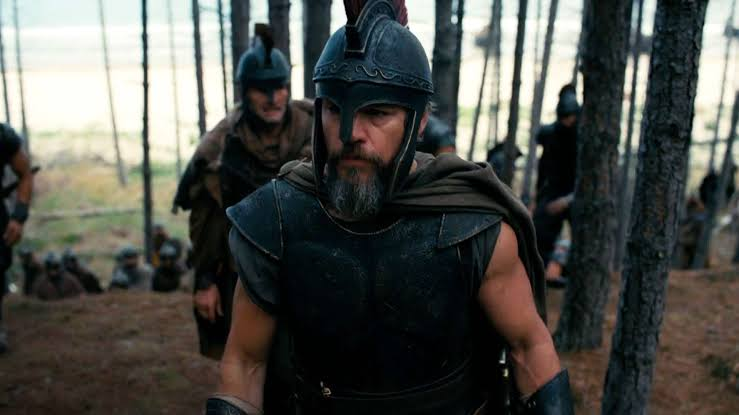
What makes this work so well is how Nolan carries over his non-linear, multi-perspective narrative format from Oppenheimer, painting a complete picture by jumping around where it is thematically important. He frames the protagonist, Odysseus (Matt Damon), as someone worn and weary, struggling to recall the many years of combat and despair that came before. The king of Ithaca led a triumphant campaign against Troy with the Trojan Horse deception. With many singing his praises, he appears as a cunning strategist. But what happened to his crew, and why has he not yet returned to Ithaca? His kingdom could really use a king with his despairing wife Penelope (Anne Hathaway) and son Telemachus (Tom Holland) losing hope. With the cruel and eager suitor Antinous (Robert Pattinson) aiming to marry his way onto the throne, a bitter Telemachus takes it upon himself to learn about and seek out his missing father. What he discovers is a history of victories and messes, revealing a complex portrait of a man who defies the gods and suffers as he reaches the limits of his ambition and leadership.
There are plenty of familiar elements from the classic story, but they’re told in a way that invites deeper contemplation of Odysseus’s dark voyage. An encounter with a massive Cyclops is presented with more terrifying horror than fantastical awe. It’s a haunting sight not merely because this monster devours the Greek soldiers and spits out their helmets like the pits of olives. The Cyclops looks more human than otherworldly, with a gangly frame and an eerily human face featuring a vertically set eye. Nolan isn’t afraid to make even the most magical moments more grimy to enhance the failure and humiliation of Odysseus. The film embraces body horror in the scene where the witch Circe (Samantha Morton) transforms the soldiers into swine, literally molding their bodies into the animal of her choice.
That devotion to making this dangerous adventure seem more real and gritty is what grounds a film that could have gotten lost in the grandiose battles of dozens of warriors and the pulse-pounding/earth-shaking score by Ludwig Göransson. Consider the Trojan Horse segment, which is portrayed as a draining experience of many men drowning and dying when hidden within the tribute. Odysseus and his devoted men, like Menelaus (Jon Bernthal), endure a horrific experience of being forced alongside dead bodies while waiting to strike. It is one of many bitter losses for this king charging into battle, where there is plenty more death in his future, even previewed amid his trip to Hades. The favoring of brutal realism in a story of monsters, magic, and communication with the dead ensures that the more fantastical moments come off more illuminating than the ordinary. The sparing use of Zendaya as the onlooking Athena has a profound effect in the few times she appears before Odysseus, offering wise words when needed and sympathetic tears when she witnesses how far this man will fall.
That natural staging also carries into the many performances as well. Characters will speak of their ambitions for power and adherence to Zeus’s law, but they’ll also berate with such flowery dismissals as “fuck off.” I’m sure there’ll be some debate and nitpickery about whether the abundant cast might not deliver the perceived cadence of this Greek myth. But they do give genuine performances that emphasize the text’s emotion rather than letting the theatrics crowd them out. Matt Damon works well for the role of Odysseus as an older man who has seen the worst of mankind, which has taken a toll on his mind and body. His ability to return home and cleanse the throne of those hungry to take advantage of his absence becomes more of a personal journey for accepting his failures than merely finding the best route. That said, when he does return, Nolan doesn’t skimp on making that showdown a thrilling note to end the movie on, running dangerously close to becoming a cathartic revenge fantasy with satisfying punchlines and stabbings aplenty.
This direction enhances even the smallest roles. Elliot Page doesn’t have much screen time as Sinon, but he delivers a powerful storm of bitter words against Odysseus in Hades; the anger never subsides amid the filthy makeup and the many dead soldiers surrounding him in this scene. Lupita Nyong’o, pulling double duty as Helen of Troy and Clytemnestra, does far more than let her face tell her story, revealing murderous vengeance behind closed doors and somber apologies whispered to ears. John Leguizamo’s Eumaeus has a lot of charm in how he quietly spits upon the many suitors of the queen, more pigish than the swine he cares for. And that’s hardly scratching the surface of how many other powerful players are given more depth than mere players in this intricate picture.
Although there is plenty of despair in the picture, there’s also great thrill in this death-filled epic. Once more, Nolan’s non-linear style comes to the rescue by tightly editing so many key events to their most powerful beats. The Trojan War is diced up throughout, progressively revealed when most suitable and from different accounts. Menelaus might stress the sacrifice and strategy that led to the taking of Troy, but Odysseus recalls the inhumanity that came with the slaughter once the gates were opened. The loss of his men weighs more heavily on his soul as the quest home continues, even if the mounting body count grows more concerning for the questioning Eurylochus (Himesh Patel). The thought placed into this character’s perception of a crumbling civilization makes the more blood-pumping moments of slaughtering giants and tremendous storms all the more engrossing.
Christopher Nolan’s The Odyssey is the ideal epic, as eye-popping in its spectacle as it is thoughtful in its portrayal of complex characters. While sharing the same storytelling/editing as Oppenheimer, the film also harbors the same interest in exploring the deepest flaws of men who accomplished towering achievements that offered little comfort to their souls. A lesser director might’ve favored a more swashbucking action-adventure or a muted recitation. Nolan proves you can approach even the most ancient retellings if you have something to say and a vision to make the story your own. For that fearless devotion, there’s little doubt in my mind that this is one of his best movies.
