
“Exit 8” Review
Director: Genki Kawamura Screenwriter: Kentaro Hirase, Genki Kawamura Cast: Kazunari Ninomiya, Yamato Kochi, Naru Asanuma, Kotone Hanase, Nana Komatsu Distributor: Neon Running Time: 95 min. MPAA: R
There’s something unintentionally hilarious about how the premise of Exit 8 becomes repetitive itself. This doesn’t make the movie bad, as it does have some remarkable shots, a tense atmosphere, and some fine performances. But there’s a feeling I can’t shake about how a horror this clever is better suited as an anthology addition. Posed as a feature-length movie, there’s the sensation of treating an entire bag of chips as lunch.
The idea behind Exit 8 is simple: individuals wander through a Japanese subway tunnel to a section that continuously repeats itself. The only way out is to recognize patterns in the repeating hallways. If it looks the same, keep going. If something is different, turn around. Do so eight times and you’re free. Miss one hallway and you start all the way back at zero. The latest victim of this twisty maze is a nameless lost man (Kazunari Ninomiya), struggling to process his girlfriend’s pregnancy and whether or not to keep the baby. The thematic drive of his grappling with fatherhood is further stressed with the added ally of a young and mostly quiet boy (Naru Asanuma), also lost in the subway. Will he care for the kid or leave him behind to save himself?
There isn’t much more to the central character than that, as he is treated to a trippy nightmare of his darkest fears. Sometimes it takes the form of doors leading to mirrors of his past self, and sometimes it’s visions of the possible future, bleeding through the purgatory of a subway tunnel. And sometimes the walls just literally bleed. Or there’s a bunch of rats that form a human face. What a weird rat race this maze becomes! There are indeed some spooky moments, but the third act mostly falls back on the final halls being extra scary with monsters and flooding the area, letting the character’s deeper psychological terror coast on more tangible waves of horrors.
I did find it a little odd that the movie chose to divide itself into three chapters that favor different perspectives when they all lead toward the one character. The anthology format could be intriguing, as we’re presented with the walking man (Yamato Kochi). He’s first seen as a voiceless ghost of the halls and later as the real person he was before, desperately trying to find a way out and willing to abandon his son. And while he fits neatly with the film’s central focus on fear of parenthood, he serves as little more than a quick cautionary tale about the deception of the halls and a vessel for a few more spooky elements.
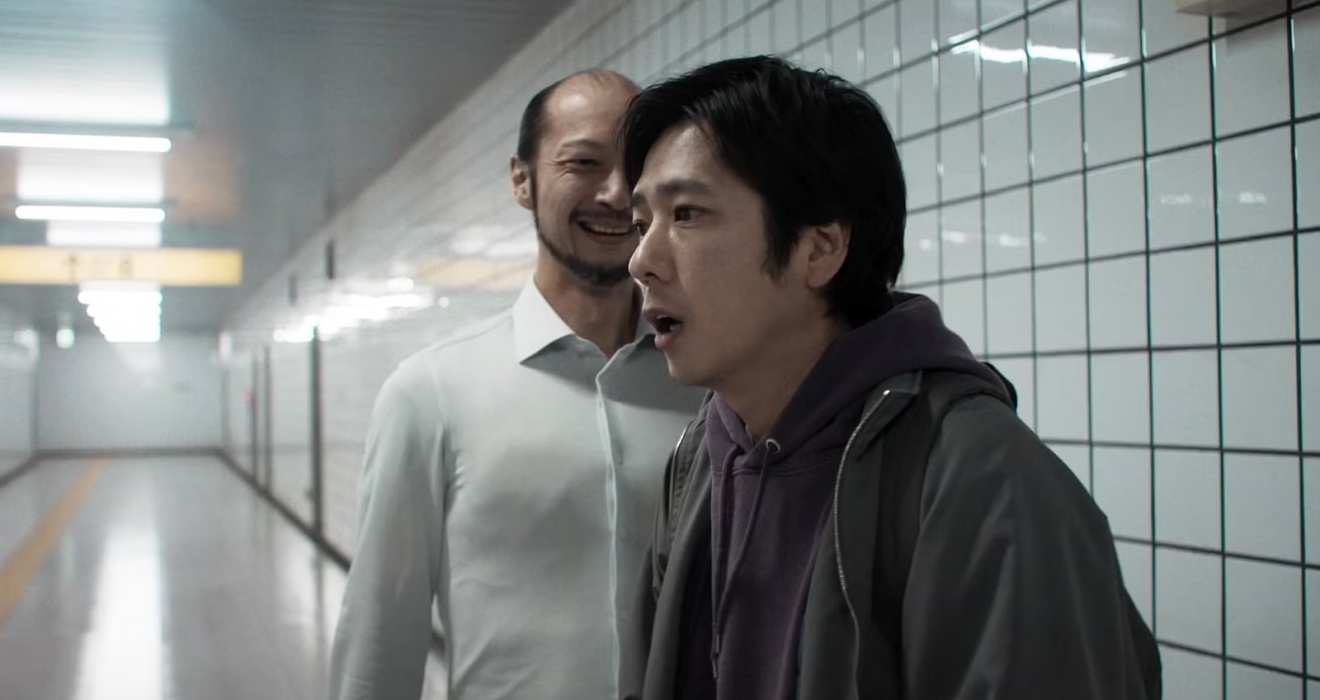
The setting of Exit 8 has so much potential that feels limited not so much by its cyclical nature, but by what it chooses to center on most. Once the themes become highly vocal on repeat, there’s a passing feeling in how the movie narrows in on escape tactics and the many frights that pop out in the endless rows of white tiles, expected adverts, and metal doors. But, to the movie’s credit, there are some genuinely scary moments, even if they come off more compartmentalized than they drive the story. Yamato Kochi deserves a lot of credit for perfectly playing the robotic version of the man expected in the halls, ignoring the protagonist as he passes by and creepily smiling when glanced at from behind. There’s an intriguing scene where the real walking man encounters a mysterious high school girl and questions whether or not this person is an anomaly that should force him to turn back. But before some juicy paranoia can set in about who to trust, the film favors some simpler scares to make this surreal location more spooky than complexly compelling.
Although it’s a premise that would serve far better as an episode of The Twilight Zone, Exit 8 mostly works with its cyclical interplay between the physical and the psychological. It’s a good concept, but unfortunately it becomes as repetitive as its hallways, making the journey less a discovery of inner fears and more like the game it was based on. But for being a little more than a haunted hallway, it works well enough to draw in the viewer and leave them with a decent dose of existential dread. For a film that spends so much time harping on the endless mundanity of commuting, it could stand to slow down and smell whatever weirder discoveries lurk in its manmade corners.