
“Teenage Sex and Death at Camp Miasma” Review
Director: Jane Schoenbrun Screenwriter: Jane Schoenbrun Cast: Hannah Einbinder, Gillian Anderson, Jack Haven, Patrick Fischler Distributor: Mubi Running Time: 112 min. MPAA: R
While many horror films are content floating in the kiddie pool of nostalgia, Jane Schoenbrun straps on some scuba gear to dive into the deeper depths of the genre. What she manages to unearth within Teenage Sex and Death at Camp Miasma is far more than just a meta commentary on modern horror retoolings or poking fun at the slasher conventions. Somewhere in the darkest corners of the mind exists a festering passion that extends beyond a thematic rooting or fan-favorite wink. As an actor so plainly spells out the appeal, it’s all about flesh and fluids.
What makes such a film work is that it refuses to be pinned down so easily. The opening sequences paint a complete portrait of the fictitious horror franchise Camp Miasma, drenched in decades of piss-poor sequels, scandalous reviews, and heaps of merchandise spanning from video games to card games. There are shades of so many horror pictures in this framing, aside from the obvious associations with Friday the 13th. It’s also a very absurd saga of films considering the killer, Little Death (Jack Haven), is masked by a square ventilation covering that looks as though it were plucked from an office ceiling. Schoenbrun doesn’t even ease the viewer into the ridiculousness, starting the movie with a kill that evokes one of the most comical geysers of blood, on par with Old Faithful.
Hired to direct a reboot of Camp Miasma is Kris Williams (Hannah Einbinder). She has a passion for this franchise, but it becomes clear she was tasked with placing her indie, queer lens on a franchise in need of something less commercially tiresome. As her agent (Sarah Sherman) describes the project, the studio wants the horror to be “elevated,” which she admits is code for “woke,” which is itself code for leaning away from the dated, problematic elements. Kris is somewhat aware of why she was given this chance, believing she’s playing the studio to make the movie she wants. Of course, what she wants is a movie that means something more than what was intended.
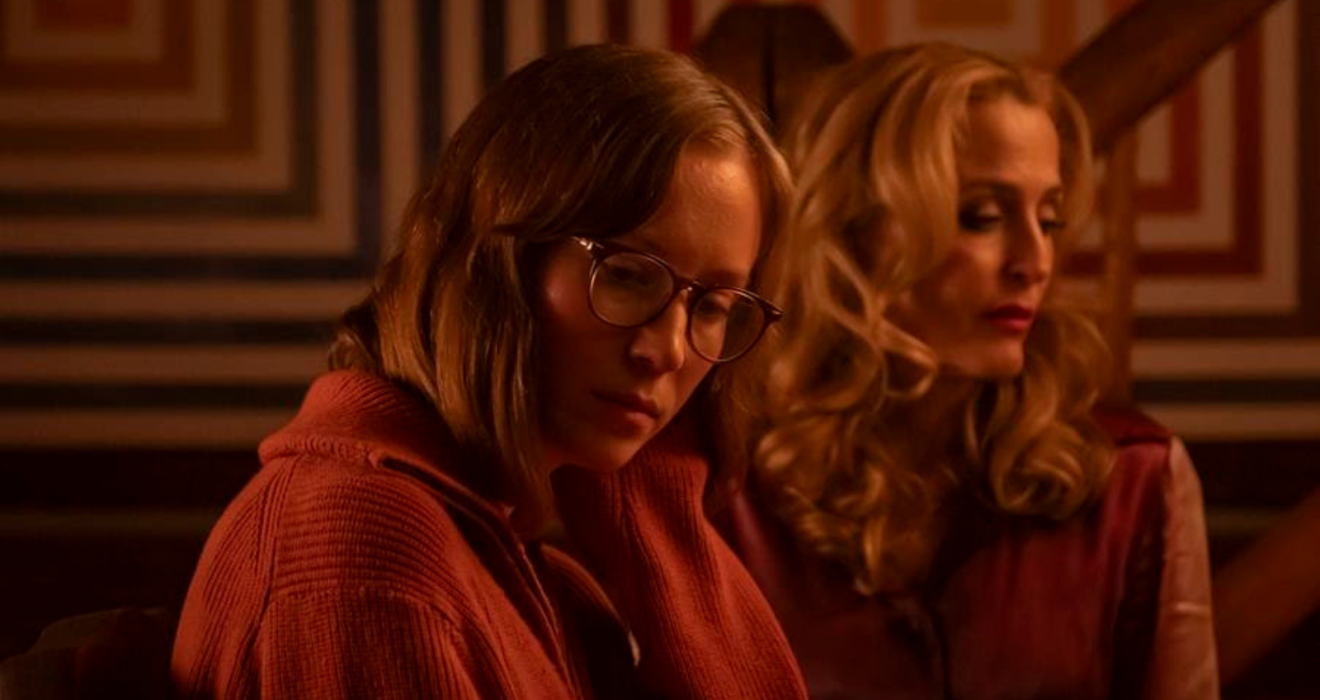
To make her dream come true, Kris spends the entire picture trying to convince the original movie’s final girl, Billy Presley (Gillian Anderson), to return for her movie. Venturing out to Billy’s off-the-path cabin, convincing Billy will require more than a robust script or a nostalgic buttering-up of this veteran actor. Billy isn’t so much interested in the movie as she is in Kris, curious to see what she finds most appealing in horror. For Billy, Camp Miasma was something more than just a personification of repression or just another acting job. It was a sexual experience that she hopes she can convince Kris to become a believer in, experienced throughout a trippy cocktail of horror movies, weed, and sex.
Schoenbrun isn’t afraid to let this story go into surreal places, but is also quick not to place it in one easily definable box. There’s likely going to be someone in the audience treating the film like a guessing game, as though there’s a simple relation to what is being staged. That need to label is itself brutalized during a pitch meeting, in which they assume the movie Kris is trying to be as meta as Wes Craven’s New Nightmare. Kris is quick to snap back that this is not the movie she or Schoenbrun is making, going so far as to reiterate the antithesis with the loud association of “fright master Wes Craven.” This isn’t Scream, Sleepaway Camp, or Friday the 13th. It is a film that wants to find something more telling about what draws us to the screen on a level where we feel something far more than fear. It’s not fully meta or satirical. It’s something far juicier.
What a wild drug of a horror movie Schoenbrun has composed with Teenage Sex and Death at Camp Miasma. I was critical of her previous picture, I Saw The TV Glow, for coming across as a one-note trans allegory that lingered more than it explored in its astute capturing of the 1990s. She has cracked open a goldmine of so much thematic allure in this picture that taps into darker and stickier corners of the genre, bringing out the most bonkers twists, wild music choices, and horniest discoveries. This is a horror movie that loves horror so much to the point of the strangest yet most satisfying of orgasms.
