
“Possible Love” Review
Director: Lee Chang-dong Screenwriter: Lee Chang-dong, Oh Jung-mi Cast: Jeon Do-yeon, Sul Kyung-gu, Zo In-sung, Cho Yeo-jeong Distributor: Netflix Running Time: 164 min. MPAA: R
Possible Love shares many familiar elements that highlight South Korea’s capitalist anxieties and woes, as seen in films like Parasite and No Other Choice. But something more fascinating lurks in Lee Chang-dong’s latest film: it explores more than the bitterness of being laid off and how that tension bleeds into a marriage. Something more primal festers within this complicated tapestry than a simple reflection of class divides and eroding romance, making it one of the year’s best films.
Following a failed strike at an automaker, the traumatized Choi Ho-seok (Sul Kyung-gu) is still processing the aftermath. Attending the funeral of one of his fellow co-workers who committed suicide isn’t easy. His muted expression, with brief bursts of frustration, is straining his relationship with his family. His wife, Ahn Mi-ok (Jeon Do-yeon), who works at a mask factory, doesn’t want him drinking to avoid his violent outbursts, but she doesn’t really set a good example with her own drinking habits. His son, Choi Cheol, lacks confidence and struggles to grow quieter, absorbing his parents’ frustrations. Ho-seok remains reserved about his feelings and refuses to go to therapy, silently managing complex emotions and reconciling with the failure of his union.
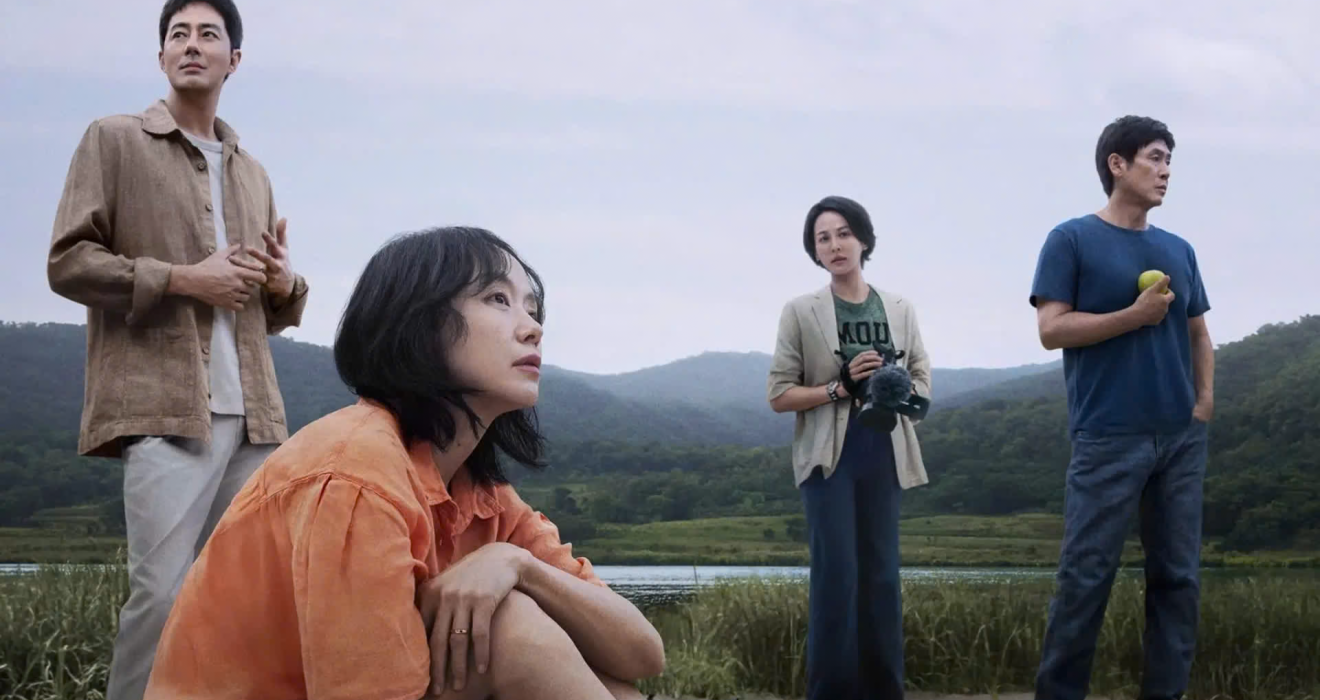
Her husband’s silence forces Mi-ok to open up to the documentarian, Lee Ye-ji (Cho Yeo-jeong). The filmmaker is trying to make a movie about laborers and highlight the hidden part of South Korea that many take for granted. But the limits of this relationship become clear when Mi-ok notices Ye-ji’s incredibly expensive clothes. Her presence makes her claim to be an independent filmmaker far less believable and more like a rich woman taking advantage of those struggling. The divide grows when Mi-ok meets Ye-ji’s husband, the charming and fit Han Sang-woo (Zo In-sung). Warm and welcoming, he teaches Cheol martial arts better and is far more charismatic and attractive to Mi-ok. He’s also rich and invites Ho-seok’s family to visit his mansion with its spacious rooms and private beach. Mi-ok isn’t just attracted to Sang-woo because of his muscles or his money. He has something far more irresistible: Freedom. The freedom to stroll down to a beach, alone, strip, and swim without a care in the world. And after enduring the silent struggles of her husband and son, it’s hard for her not to gravitate towards the friendship of Mi-ok and the sexy body of Sang-woo.
Lee Chang-dong has an amazing ability to pose such a drama that is anything but predictable. The wealthy couple might seem like simple antagonists with their affluent lives, but they’re still flawed in their interactions. In addition to Ye-ji’s accidental flaunting of her expensive apparel, Sang-woo takes note of how her sympathy for labor is more artificial than real. Although Ye-ji tries to stress that she’s friends with Mi-ok, her guilt and inability to connect are clear and hard to ignore. Sang-woo isn’t much better, as he shows off an old family police whistle at his mansion. Given Ho-seok’s violent encounter with the police amid a strike, this would be a triggering sound to hear. Yet when Sang-woo blows the whistle, there’s not much of an expression from Ho-seok. Whatever he’s feeling is kept deep within, and it’s almost maddening to watch him silently endure this vacation.
Many scenes have an almost haunting quality, as they explore the depths of Ho-seok’s damaged soul. He is most intriguing in how he interacts with his former co-workers. He meets one of them directly when he calls for a ride, and an uncomfortable distance emerges as the former worker refuses his services and leaves promptly. When Ho-seok spots another co-worker who doesn’t recognize him, he quietly follows him as he purchases a birthday cake for his kid’s birthday. He follows this old comrade to the joyous birthday party, but keeps his distance as he observes the celebration in silence. Why is he doing this? It’s not just envy of a better parent or loneliness from struggling to find a peer. It’s something he can’t quite explain, but there’s a sensation there that feels all too relatable, with the most eerie quality.
There is always a fascinating duality that extends beyond the expected comparisons of sex and money. The most compelling angle is how Ho-seok and Mi-ok deal with unions. With Ho-seok’s work, the union’s struggle was long days of sit-ins and ended in a violent clash with the police. With Mi-ok’s work, a union forms at her job within a day, with little resistance. Ye-ji even catches the formation on film, giving her something more exciting for her documentary. She was hoping that Ho-seok would be more open about his traumatic experience, but it takes him a very long time to talk about it. But once he does, it leads to one of the most unforgettable moments. The way Ho-seok breaks down with all his fears and anxieties about feeling like a failure and losing faith in unity is gut-wrenching. He explodes with all these bottled-up thoughts in an avalanche of insecurity and regret for a world that he feels has failed him, and vice versa.
Every moment in the film has an awkward edge as they struggle to find the right words and expressions, where something as simple as Mi-ok recovering her missing wedding ring brings tears. But there is Ho-seok, in front of Ye-ji’s camera, divulging the events that brewed his frustrations and unloading them all at once in a tearfully relatable scene. Even as he’s spilling his guts, there’s still uncertainty about how to process this honesty, as he darts between anger and panic with every bottled-up feeling exploding like uncontrollable fireworks. And even after such a vocal, visceral display of the invisible barrier between these two couples, the film somehow keeps going and finds even more catharsis and connections, so thoughtfully relatable in that there’s never a simple resolution to any of this.
Lee Chang-dong’s Possible Love never misses a beat in defining a humanistic story so complex and mesmerizing that it defies any simplistic route one might expect. From the difficult feelings of being lesser to the uncomfortable gulf of trying to document a fall from grace, the film’s endlessly thoughtful approach unearths so much from these four fully-defined characters. It extends far beyond jealousy, wealth, and a yearning for freedom, reaching the core of what makes us ache for more in this life, even when we don’t know what we’re searching for. I’ll be thinking about this film for a long time, and chief among those iconic moments will be the scenes of Sul Kyung-gu’s performance, where he breaks down with immense vulnerability. Few films have captured so many difficult feelings with such heavy emotional resonance.