
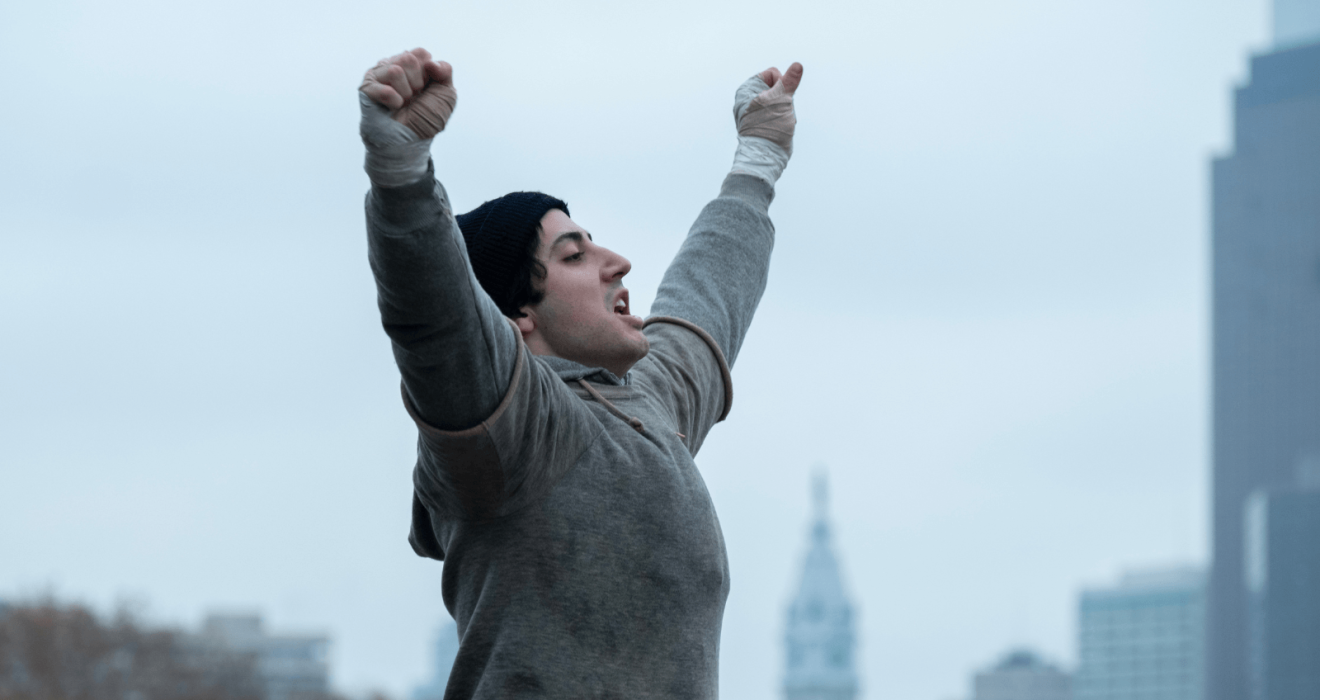
“I Play Rocky” Review
Director: Peter Farrelly Screenwriter: Peter Gamble Cast: Anthony Ippolito, AnnaSophia Robb, Toby Kebbell, P. J. Byrne, Jay Duplass, Matt Dillon, Stephan James, Tracy Letts Distributor: Metro-Goldwyn-Mayer Running Time: 128 min. MPAA: PG-13
Based on a film with incredible build and driving momentum, I Play Rocky is a biopic that feels more like a patchwork of interesting tidbits than a cohesive whole. It tells fascinating stories about how Sylvester Stallone struggled to make Rocky, an incredibly risky sports film for the 1970s that took a lot out of him, financially and physically. Although the film rarely achieves much beyond a handful of amusing scenes, it still has enough charm to be a crowd-pleasing watch.
The film sets its tone decently enough in its first scene, with Anthony Ippolito as Sly Stallone. Before Rocky even became an idea, Stallone struggled to become an actor, and his audition for a small role didn’t go well. There’s snickering in the darkness of the stage and a dismissal from the casting director, but there’s a mild acceptance of Ippolito selling the role of Stallone. Ippolito runs close to parody, but he’s playing the role earnestly enough to sell the part. So, where does the film go from here? Well, for its first act, it speedruns through the events leading up to the writing of Rocky. We see Stallone get kicked out of his room in the city and care for a puppy on the streets. We watch a romance promptly spring up from Sly’s attraction to the ticket seller Sasha (AnnaSophia Robb). Acting roles remain just out of reach as money becomes an issue. Figuring he won’t find any roles suitable for himself, Sly commits to writing screenplays, which also struggle to earn the attention of scrutinizing producers. Coated in montages and quick jumps in time, there’s rarely a moment to consider the plight, which somewhat highlights Stallone’s narrow goals but also makes you wonder why the film didn’t get to the real meat sooner.
Around the second act, the film finally finds its groove in producing Rocky. Producers Robert Chartoff (Toby Kebbell) and Irwin Winkler (P. J. Byrne) have fun chemistry as they debate with a determined Rocky about making the movie. They take particular issue with Stallone wanting to star in the movie he wrote, leading to a series of contract disputes that could’ve been an entire movie. Even when the film is approved for production, the arguments continue on set as problems arise on this tight budget. Again, this could’ve been the entire movie, especially given how engrossing the film production becomes. The many factoids about how the iconic stair scene was filmed and how the crew hid from unions on set are entertaining. There are some great punchlines going into production about how Carl Weathers (Stephan James) admits in the ring he can’t box, and Talia Shire (Kiki Seto) confesses she can’t skate before the big skate scene after the film has gone well over budget. Even small moments have some laughs, such as when the determined director John G. Avildsen (Jay Duplass) angrily tells Burgess Meredith (Robert Morgan) to get lost during a crucial scene he’s not needed for.
During filming, the director tells Stallone that every great movie needs that “thing,” referring to the scene that defines the movie, akin to what Nicolas Winding Refn called a film’s heart. For Rocky, the movie within this movie, the most important scene is when Rocky bitterly rants about his life. But in I Play Rocky, where is that crucial scene? I regret to admit it might be the same scene, and more for the mere replication. This movie certainly had potential for better scenes. I started perking up when Matt Dillon showed up as Stallone’s father, but the talk of an abusive childhood and failed dreams never really extends beyond a few conversations about an excused generational divide. The romantic scenes between Sly and Sasha feel more obligatory than sweet, where any friction between them seems to resolve in mere seconds. Even the sad moment of Sly selling his dog to make ends meet doesn’t feel as gut-wrenching as it should, nor does the comforting moment of Sly buying his dog back once he makes enough money.
Peter Farrelly directed the film and, much like his last film Green Book, it’s clear he’s better at handling comedy than drama. The moments that work are when the film finds the absurdity in the scrappy production of the little boxing movie. I appreciated the comedic energy he wove through the behind-the-scenes chaos. That comedy was far more engrossing than the moments of dramatic tension over whether Stallone will pay his rent or whether his body can hold up under the demands of a tight shoot. Part of the problem is that the film is diced up; it never has time to let any of its more serious moments simmer beyond melodramatic bullet points. Jokes are easier to work in for this uneven assembly, and it’s more surprising how much of them work in this highly questionable edit.
I Play Rocky lands some satisfying comedic blows, but its uneven drama throws limp punches as a biopic. The limitations show in a film that feels more like a collection of on-set stories than a complete film about Rocky’s production. At the end of the picture, Sly Stallone can take some relief that he’s made one of the best movies of the 1970s. By the end of this film, I’m relieved this movie wasn’t as bad as it could’ve been, ensuring it won’t be the worst of 2026, but also nowhere near the best.