
“VisionQuest” Review
Director: Terry Matalas Screenwriter: Terry Matalas Cast: Paul Bettany, James Spader, Ruaridh Mollica, Todd Stashwick, Lauren Morais, Orla Brady, Diane Morgan, Polly Frame, Henry Lewis, Jonathan Sayer, Emily Hampshire, James D'Arcy, Ben Crompton, T'Nia Miller Distributor: Disney+ Running Time: 60 min. x 8 episodes MPAA: TV-14
Following the hero’s odd rebirth in WandaVision, Vision is staged creatively and compellingly in his first TV series. If you haven’t caught up with the Marvel Cinematic Universe since Paul Bettany’s character last graced a Marvel production, there’s no need to worry. This version of Vision is in a similar predicament. Although created from Vision’s data and image, this new model struggles to learn as much about Vision’s history as it does about the world around him. For a character that is essentially an AI housed in an android body, this show manages to find some fun stuff to do with the character, even if it predictably ends on the expected notes of a superhero battling a supervillain.
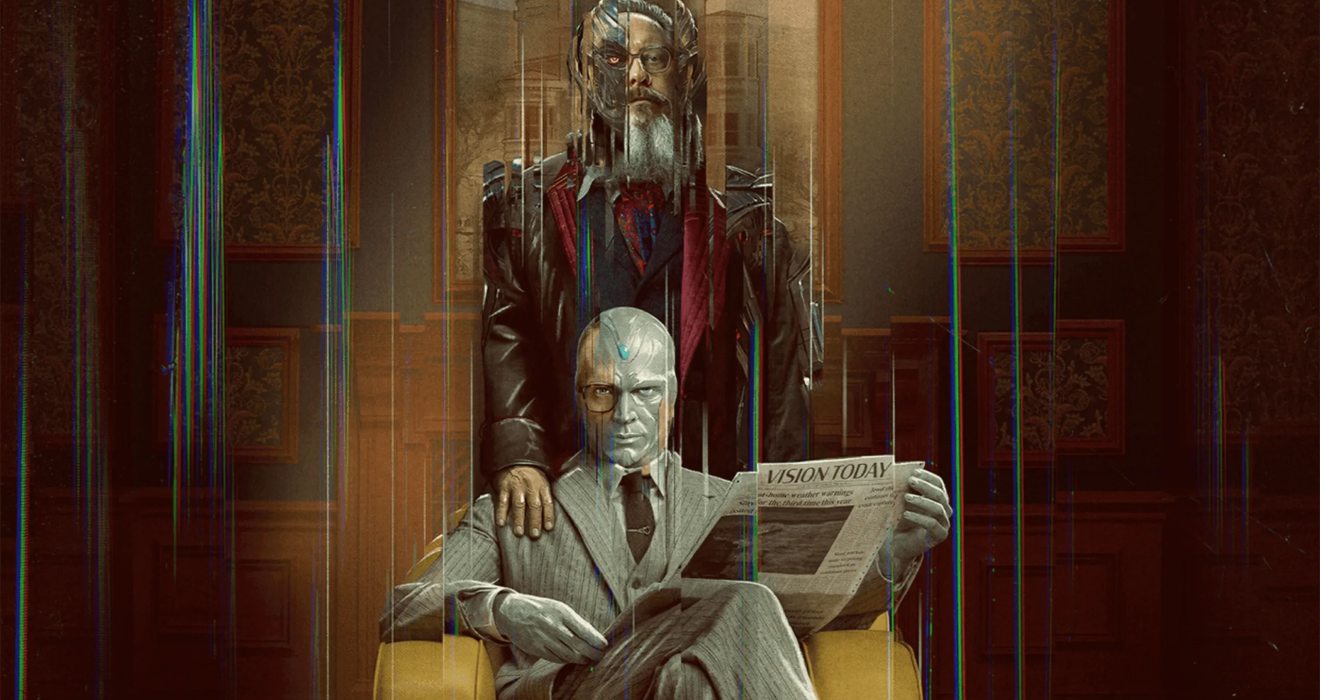
It helps that Vision has a vivid imagination, making his inner workings far more compelling. The show takes place between two worlds: the reality where Vision tries to adjust to humans and his own head, where he forms strategies amid a charming English estate. He’s not alone either, as he’s housing a few other AI characters to help him out. This includes familiar models developed by Stark Industries, spanning from the stern J.A.R.V.I.S. (James D’Arcy) to the gung-ho E.D.I.T.H. (Emily Hampshire). Among the most dangerous, however, is Ultron (James Spader), who has apparently been preserved by Vision. As someone to speak with, it’s easy to see why Ultron was kept around, especially for his snarky comments and insight, delivered by Spader as a bearded intellectual, debating whether art is strong enough to reject destroying all of humanity (he could go either way).
Vision’s mission of integrating into society takes a backseat when he becomes the target of an assassination. Once the bullets fly, it’s all hands on deck to figure out who is targeting him and why. Naturally, solving the mystery requires intense processing, leading to many scenes in Vision’s cozy English interior as his avatars debate strategy in dapper attire. The series even includes charming cameos by familiar English actors who play up their greatest strengths. These scenes become a highlight of a series that does struggle to make its lesser reality all the more engaging. Pursuing Vision is an assassin called Paladin, and he’s got some charisma when portrayed by Todd Stashwick, but his look and backstory are nothing all that compelling. The other mystery is the appearance of Tommy Maximoff, played this time by Ruaridh Mollica, which forces Vision to question how his kid escaped Wanda’s magic and whether he’s willing to be a dad unbound by sitcom logic.
There’s a better flow in this spin-off than in other MCU shows because it never loses sight of where the real meat of this show lies. Vision’s world-altering inner realm is visually stunning and intriguing, portraying processing power and coolant through household elements while embracing the stylish production and what it represents. The dialogue battles between Bettany and Spader are fun, as they debate the nature of humanity, with sparks from Vision’s empathy and Spader’s absurd bluntness. Although the film eventually settles on a Marvel villain and slips into the predictable superhero-versus-supervillain fight, it never loses sight of the far more exciting mental battle. It’s more enticing to watch Vision argue against extinction with Bettany’s strong words than fighting off Ultron’s strong CGI fists. Thankfully, there’s way more of the verbal fights than those heavier on the expected special effects.
Even when weighted by the typical tropes of Marvel TV shows, VisionQuest succeeds in being one of the brighter shows in the MCU lineup. The performances are a lot of fun, especially because they bring out more of Paul Bettany’s natural acting, without being constantly coated in an abundance of deep colors or no color at all. Spader is way more compelling as a bearded critic than a mass of nanomachine parts that smacks around superheroes and waxes about how humans need to be obliterated. There’s even a little warmth in Vision’s connection with Tommy, resulting in some father/son bonding that feels solid enough to see where it goes, beyond concocting a reason Tommy even came back. This show dares to explore the more intriguing ideas of Vision, revealing his ability to process faster than reality and how he perceives his social interactions, especially when damaged and struggling to stay composed. That commitment to the avatar format, and the refusal to abandon it when it’s time for the expected battles, is worth far more than whatever connection the show has to the rest of the Marvel Cinematic Universe. Maybe it does set something up down the line, but I honestly don’t care. All that matters is the present, and VisionQuest makes what is essentially a squabble between AI avatars way more amusing and thrilling than I’d ever thought.