
“You Can See Everything” Review
Director: Nathan Fielder, Lance Oppenheim Cast: Elizabeth Holmes, Nathan Fielder, Billy Evans, Amanda Seyfried Distributor: A24 Running Time: 174 min. MPAA: R
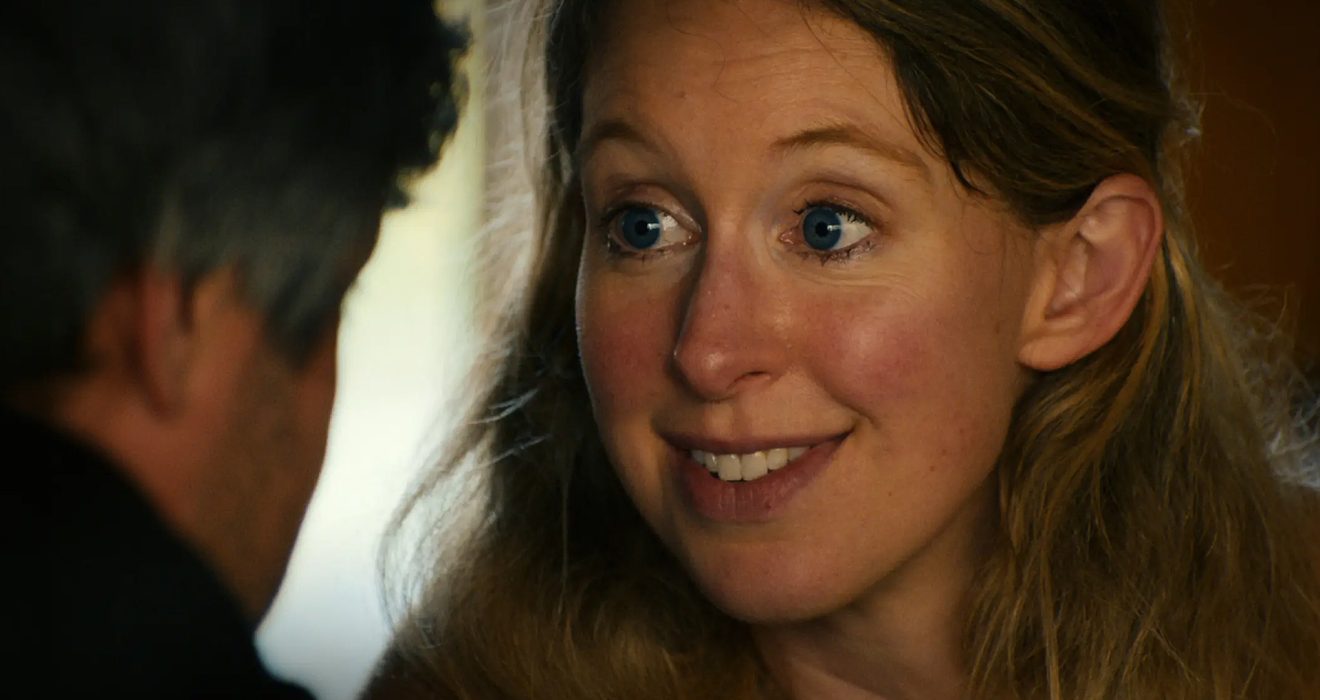
The longer you stare, the stranger this movie becomes. Nathan Fielder’s documentary closely examines Elizabeth Holmes’s life in the days leading up to and after her imprisonment for fraud. She agrees to the documentary and makes it clear to Nathan that he can film as much as he wants and ask whatever he wants. Her life is an open book to him, but one written in small type and cryptic words. He stares deep into her massive eyes during several interviews, where an awkward silence lingers. There’s something more behind those large pupils and toothy smile. Something so deep that Elizabeth’s open nature feels less like an invitation and more like a dare, curious to see how far Nathan will go with his film. He plunges deeper than I think even those familiar with Nathan’s work will expect. What he unearths is as stunning as how many times my jaw dropped to the floor at revelations that not only question Holmes, but the very nature of documentary filmmaking itself.
Nathan has immense curiosity, but also a quiet nature strong enough to draw more out of his subjects. One of the earliest questions he asks Elizabeth is why she’d agree to an interview when he knows little about the medical science she was known for. Perhaps she thinks that lack of knowledge will make it easier for her to avoid harsher questioning and paint a more sympathetic portrait of her family before she leaves them to serve time. It’d be an ideal way to humanize the guilty, since she spends her final days at a beach rental with her husband and two children, one of them a wee baby. But while Nathan might not know much about the tech behind her Theranos device, pitched as able to run a variety of tests from a single blood sample, he understands how people deceive, and something clearly feels off in his many interactions with, and filming of, Elizabeth.
One can’t help but pry when Elizabeth keeps insisting she did nothing wrong to warrant such punishment by the public and legal system. While some might point to the facts of her case to prove she committed fraud, Nathan digs deeper into why someone feels the need to lie. When he asks whether she ever lied, she says no, prompting him to ask how she defines a lie. The further he probes, the more he realizes there’s a gap in her communication, where she can’t read even the most common jokes. Her literal nature stems from concern for Nathan, but her husband, Billy Evans, brushes it off as a quirk of how she thinks. Where others might scrutinize, he embraces this lack of understanding with love. But it’s a stern love that signals something more frightening about this relationship.
Like Elizabeth, Billy is open about what Nathan can film, even letting him film him naked in the shower after a workout. But Billy turns out to be far more guarded and protective, his face harboring more of a resting grimace than a defensive grin. Billy’s deception is different, one that builds a defensive barrier the further the questioning goes. He can’t keep everything locked away, but wow, does he try to keep from spilling too much about himself and his family. The husband cuts off a brief discussion of what Elizabeth stands to gain from Billy’s background when he realizes the talk of money makes him look bad. A confession from Elizabeth’s father prompts Billy to stress that they should spend more time with family than on interviews. Billy’s controlling presence becomes far more frightening than Elizabeth’s sweetly delivered denial.
Once you start noticing these clues, you might think you can accurately predict where everything is going. The relationship and the schemes seem to be coming together to paint a convenient picture of fraudsters. But the film only gets stranger as Nathan’s fascination extends beyond Elizabeth and Billy. He takes further notice of how the media portrays Elizabeth and how it might contort that portrayal. And, yes, Nathan includes himself under the tent of this circus, questioning his own movie as the filming progresses. While filming, he considers the most notable depiction of Elizabeth Holmes in the miniseries The Dropout, where Amanda Seyfried portrayed her. This isn’t just a mention with a discussion of accuracy and a handful of clips from the show. It becomes a source of fascination for Nathan, taking odd turns as the film progresses and constantly tinkering with the line between easily spun fiction and the truth, which becomes harder to capture on film.
It is fitting that Lance Oppenheim co-directed this film, whose recent film Primetime explored how much truth and personal ambition bled through the TV screen in the program To Catch a Predator. Here is a picture that reveals something the public believes it understands clearly through the media we consume, whether through television exposés or published books on the topic. I’m sure many will write off this movie entirely as though it’s merely a review of Elizabeth Holmes, drawn from news articles, podcasts, the miniseries, and the book Bad Blood. What more could there possibly be to explore? Nathan seemed to feel as much before entertaining this project. But even though he’s used to going down rabbit holes with his focus, this particular issue plunges into the deepest depths. This isn’t a film that frames Elizabeth as an innocent entrepreneur, nor does it merely frame her as someone Billy manipulates. There’s a connection so compassionate yet sinister that even Nathan struggles to grapple with it as he nears a conclusion that still leaves him uncertain about the world.
I have never seen a documentary so marvelously twisty yet emotionally thoughtful as You Can See Everything. It’s hard to convey how many conversations in this film made my eyes widen and my spine straighten as I leaned in to take in every careful word and intimate moment with such fascination. But just before taking satisfaction in the juicy info Nathan has uncovered, there’s always that quiet moment of reflection. That crucial moment of deciding where to go next with what you’ve learned. Do you publish your findings and call it a day, or do you try to dig deeper into the motivations? Nathan chooses the latter, and the longer he explores his subjects, the more revelatory the documentary becomes. The film captures so many moments that will stick with you forever, but the one I keep thinking about is Nathan’s earliest moment of being flabbergasted. When he hears the lies Elizabeth told and accepted about her Theranos device, Billy interjects with, “I know what you’re feeling.” “No, you don’t,” says Nathan with a scoff. It’s a sobering moment of clarity when trying to understand people who think they know how to manipulate others, including themselves. This is far more than just the Elizabeth Holmes documentary and shapes a much different perception of the world when you come out the other side.
