
“Fatherland” (2026) Review
Director: Paweł Pawlikowski Screenwriter: Paweł Pawlikowski, Hendrik Handloegten Cast: Sandra Hüller, Hanns Zischler, August Diehl Distributor: Mubi Running Time: 82 min. MPAA: Not Rated
Paweł Pawlikowski’s films always have this haunting quality. Though Ida and Cold War were set in historical eras, the world around the characters always felt intimidating, as though they were walking through another realm. Fatherland is yet another of these surreal voyages for the following Germans who return to a post-Nazi Germany. While it still has some of that visual allure and thoughtful meditation on a ravaged land, this adventure seems to rush through its black-and-white odyssey, even as it retains that slow-burn sensation.
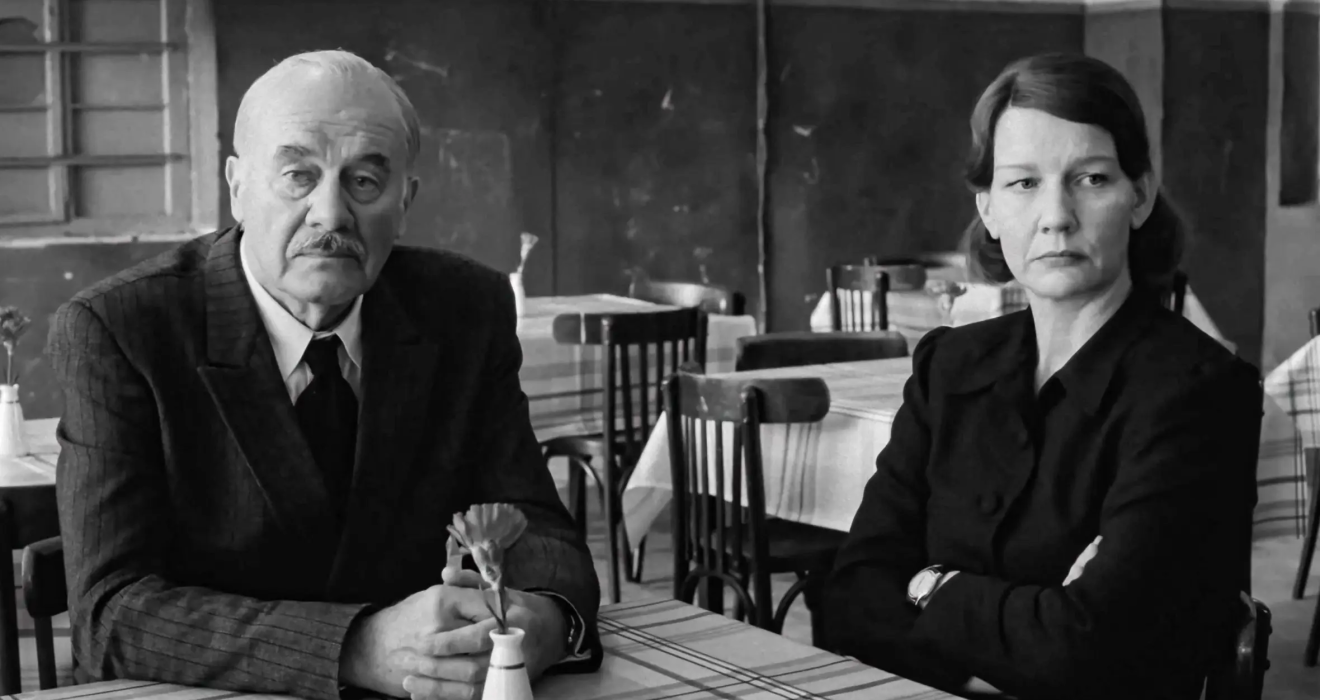
Taking place in 1949, Erika Mann (Sandra Hüller) accompanies her father, Thomas Mann (Hanns Zischler), on a trip back to Germany to accept the Goethe Prize for Thomas’s writing. The voyage is one that has a surreal quality, where Erika and her dad confront a nation that either hasn’t let go of the fascist era or questions them for leaving their homeland behind. Ericka’s disillusioned brother, Klaus (August Diehl), feels extra depressed about losing a sense of place in the world. His reluctance to attend his father’s celebration, despite the heartfelt pleas of his sister, ultimately leads to his suicide. Bitter about this development, Ericka’s resentment toward their family’s state festers, and her father’s writing grows more hollow the more he rehearses his speeches. A flood of conflicting emotions trickles out as the father and daughter progress from Frankfurt to Weimar, taking note of the shifting communities and aging relics of a Europe they left behind.
The film explores complex emotions through the people the family encounters on their return to a divided country. After Thomas’s speech, Erika notices her ex-husband, Gustaf (Joachim Meyerhoff). At the after-party, we learn that he was a capitulating actor who worked with the Nazis rather than condemning them. His brushing aside of such politics grows increasingly aggravating to the point that Erika gets physically violent with her former partner. At the same time, Richard Wagner’s grandsons approach Thomas, trying to get the highly regarded figure to portray the composer as less associated with Hitler. Though less violent than his daughter, Thomas declines to be part of such a whitewashing of history. But there are others who beg Thomas to recognize what is going on with the Soviets, who are quickly silencing any remarks made about political prisoners.
A handful of quiet moments let Pawlikowski give Hüller a chance to get lost in her thoughts as she mills about a Germany rising from the ashes. The stark black-and-white cinematography has an eerie yet intoxicating quality, as the camera always frames a world so towering. So much is changing that the new lyrics of the German anthem, which refers to the country as Fatherland, sound more eerie than comforting. Early in the film, when questioned by the press, Thomas is asked directly how attached he is to Germany after fleeing during the war. Of course, he says that if he had stayed, they would have killed him for his writing, and he wouldn’t have been able to continue his work. But a deeper existential question remains: can they call Germany home again? The rumblings of lingering fascism may signal a country that may never recover in the wake of such national shame. In trying to find something to keep living for, Erika’s emotional words pull her father out of the comfort of his writing to recognize the world more clearly, not with cynicism but with a greater sadness about what is lost. He may write that Germany must mourn but move on, but there’s clearly so much mourning to do for the writer who postponed his son’s funeral to accept another award.
Fatherland might not be the strongest entry in Pawlikowski’s trilogy of profound historical dramas, but it still has its moments of cathartic dialogue and mesmerizing shots. I think the biggest issue is that it’s the trimmest of his films, clocking in at a mere 82 minutes, leaving little time for the emotions to stew. Roger Ebert used to say no great movie is too long, and I can’t help but think that if this picture were willing to go a few more miles and venture into a few more corners of Germany’s post-war rebuild, this could’ve been a great movie rather than a brisk yet satisfying hike through Pawlikowski’s dramatic hallmarks. Even with a tighter runtime, it still leaves time to breathe in Germany’s evolving politics and philosophy, questioning where to go when no place feels quite like home. It’s a deep thought for a movie that deserves more depth.