
“The Social Reckoning” Review
Director: Aaron Sorkin Screenwriter: Aaron Sorkin Cast: Mikey Madison, Jeremy Allen White, Jeremy Strong, Bill Burr, Wunmi Mosaku, Betty Gilpin, Billy Magnussen Distributor: Sony Pictures Releasing Running Time: 112 min. MPAA: R
Aaron Sorkin’s The Social Reckoning will likely draw comparisons to his previous Facebook movie, The Social Network, and that’s a rather unfair assessment. While the rise of Mark Zuckerberg’s questionable social media website made for a rousing tale of the tech business and betrayal, Sorkin’s follow-up is more of a steady dose of investigative journalism that revealed the website at its worst. You won’t see any rousing parties or heated feuds between co-workers, as the whistleblowing on Facebook’s algorithm is nowhere near as exciting. The only returning presence from that film is Sorkin’s crisp writing, which makes this laborious investigation a little more engaging than a procedural.
The film divides the case into a non-linear format to broaden the scope. We’re introduced to Frances Haugen (Mikey Madison), a data engineer at Facebook’s civics group who is growing increasingly disturbed by the company she works for. She starts noticing how quickly misinformation is spread through the public and how little Facebook is willing to do to prevent hate groups from spreading on the platform. To get this info out from behind Facebook’s locked doors, she’ll have to rely on Wall Street Journal reporter Jeff Horwitz (Jeremy Allen White). The only problem is that Jeff isn’t much of a tech journalist and will have to rely on Frances walking her through how Facebook’s algorithm favors rage for engagement.
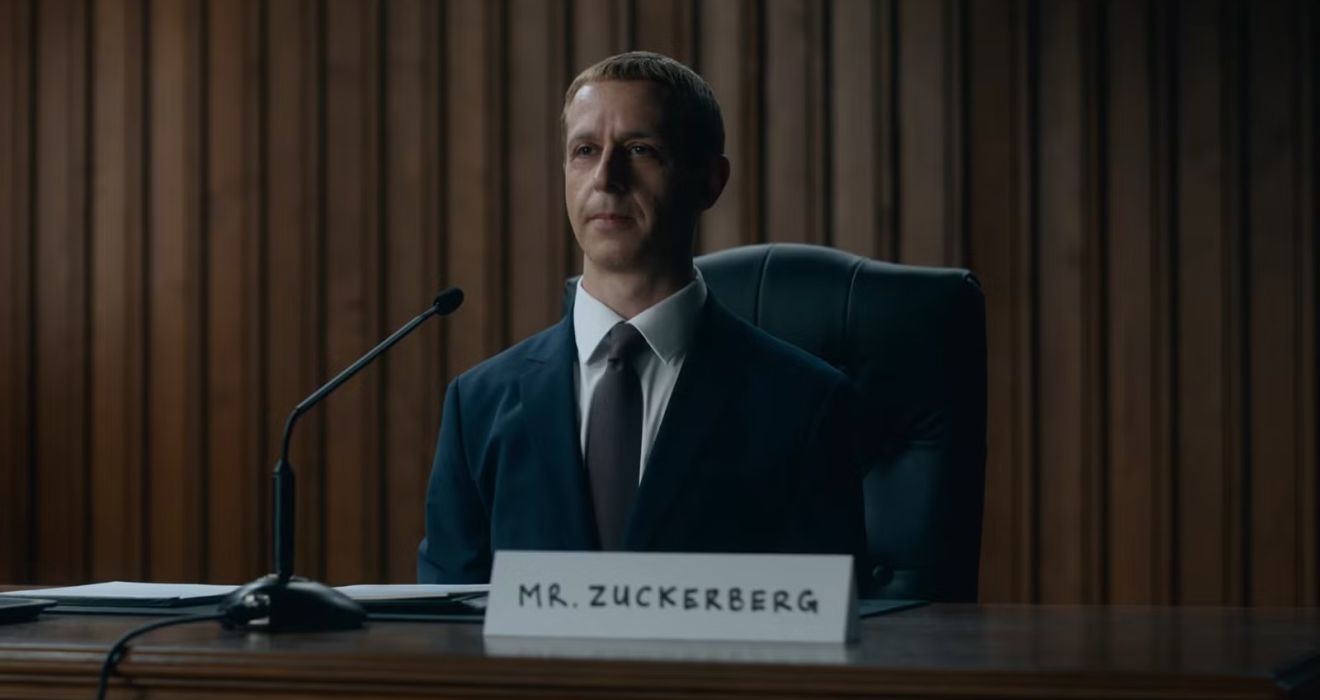
While that investigation progresses from 2019 to 2021, the film will divert to the practice hearings for Facebook CEO Mark Zuckerberg, portrayed this time by Jeremy Strong. The framing echoes Sorkin’s previous screenplay, Steve Jobs, focusing on behind-the-scenes discussions before going on camera. Strong’s performance showcases an eerily stern Zuckerberg who, while straight-faced, still harbors scorching cynicism about being questioned. His interactions become most heated with his legal counsel, Charlie, played with critical fury by Bill Burr. The two debate the problems that have arisen when Zuckerberg refuses to fact-check the grotesque politics and misinformation that have spread. It all leads to the flashpoint of the January 6th insurrection at the Capitol, where Zuckerberg might have to regulate the monster he’s allowed to fester and grow within the algorithm.
Sorkin put a lot of thought into this script. He outlines the complex web of Facebook’s wrongdoings in a manner that never feels too mechanical or simplified. Painting this fuller picture lets the film explore the problems inherent in the Pandora’s box we call the internet. In one scene, a parent tells Frances about their daughter being bullied on social media. He bitterly suggests that when it comes to platforms like Facebook and Instagram, the plug should be pulled. The situation cannot be resolved that easily, but it’s easy to see why someone would want it to be. One might also question why Frances would even work at Facebook in the first place. She explains why in a way that captures why social media is ubiquitous for many and essential for some on a personal level. It’s a connection that Frances still holds, even while revealing Facebook’s nasty algorithm.
This is not an easy subject to tackle, and Sorkin seemed almost doomed to sand down a few edges in trying to decipher this true story. While his script works, I don’t think his direction is as slick as David Fincher’s, who created an engrossing atmosphere with The Social Network. Sorkin keeps us more locked into the mode of a legal thriller with a rather standard and understated soundtrack by Alexandre Desplat, which is certainly no Reznor/Ross score. Keeping the film locked into this rigid journalism framework strips it of so much that the final scenes seem to fall back on the expected notes, so predictable that one almost wants to blush at how familiar this seems for the most unorthodox of legal cases.
But where Sorkin’s direction works best is with the cast. Everybody is in top form. Mikey Madison and Jeremy Allen White have strong chemistry, with Madison’s vulnerability and White’s curious nature. The verbal battles between Jeremy Strong and Bill Burr are fascinating: both are clearly furious but never raise their voices to a level that becomes too dramatic. A film like this could’ve easily fallen into this trap by making Strong shout and letting Burr blast off with his familiar mode of ranting, but it doesn’t. They both stick to their characters, and Strong’s ability to present Zuckerberg at his most frustrated without turning him into a cartoon villain makes his performance the finest in the picture.
Something I admired about Sorkin’s writing is that he tries to take in the broader scope of the issue. This was an aspect I found severely lacking in the documentary Your Attention Please, which argued for more laws restricting children’s use of the internet but didn’t seem to account for effects beyond comfy suburbs and active cities. The Kids Online Safety Act was criticized for how it would be weaponized against the LGBTQ community, and it’s an aspect that those interviewed sweep under the rug. And what about teenagers in communities where they don’t have supportive parents or alternatives to going on their phones and connecting with others? Online security and radicalization are too complex to fix with a single bill full of loopholes. Sorkin’s film addresses this by portraying Frances as someone who still believes in the value of what social media offers, arguing for regulation rather than burning it to the ground. It could’ve done more of that, considering we get far more of the toxic byproducts in the form of bad medical advice and the January 6th insurrection.
The Social Reckoning may not have the same cultural heft as The Social Network, but it’s a steady investigative-journalism tale with fine performances and touches of nuance. The powerful cast and Sorkin’s focused script, with a few notes of humor, outweigh his directorial shortcomings as he tries to fit this meticulous story into the limitations of a legal drama. The dialogue that compares this case to the Pentagon Papers perhaps reveals a little too much about how depicting the Facebook leak isn’t the most glamorous of stories. Sorkin still tries to climb that mountain, and it’s impressive how far he manages to ascend compared to most with such a subject.
