
“The Mosquito Bowl” Review
Director: Peter Berg Screenwriter: Peter Berg, Mark L. Smith Cast: Nicholas Galitzine, Bill Skarsgård, Ray Nicholson, Tom Francis Distributor: Netflix Running Time: 127 min. MPAA: R
Based on a true story, The Mosquito Bowl is a brutal misfire of a war movie built around a unique event during World War II. During the conflict, American troops sent to Japan played a football game to boost their spirits. One would think that director Peter Berg would be a good choice for such a film, given his history with the football drama Friday Night Lights. Unfortunately, this biopic gets so lost in the noise of war and football that explosive carnage and vicious ball-busting drown out any thematic appeal.
Something was amiss from the start: the film opens in December 1941, introducing its central young men on the football field. We watch Tony Butkovich (Ray Nicholson) making touchdowns amid other players like Dave Schreiner (Tom Francis) and Bob Baumann (Bill Skarsgård). We see John McLaughry (Nicholas Galitzine) strutting his stuff on the field for Brown University. These sequences are edited with lots of cheering and plays, but there’s never much time to get to know the players, beyond how much they love American football.
Then the attack on Pearl Harbor happens, and these men answer the call to enlist in the military. The news doesn’t feel that devastating when it’s portrayed through montages of archival footage, chopped up like a TV documentary. The urge to enlist doesn’t feel that passionate, and it doesn’t feel like a massive change for football players used to rough training. They arrive at boot camp to face a loud and aggressive authority figure, barking out orders in a tone they’ve probably heard from coaches. The brooding music suggests something darker is on the way and that these boys are in for shocking revelations about the nature of war and the hideous traits that come with it.
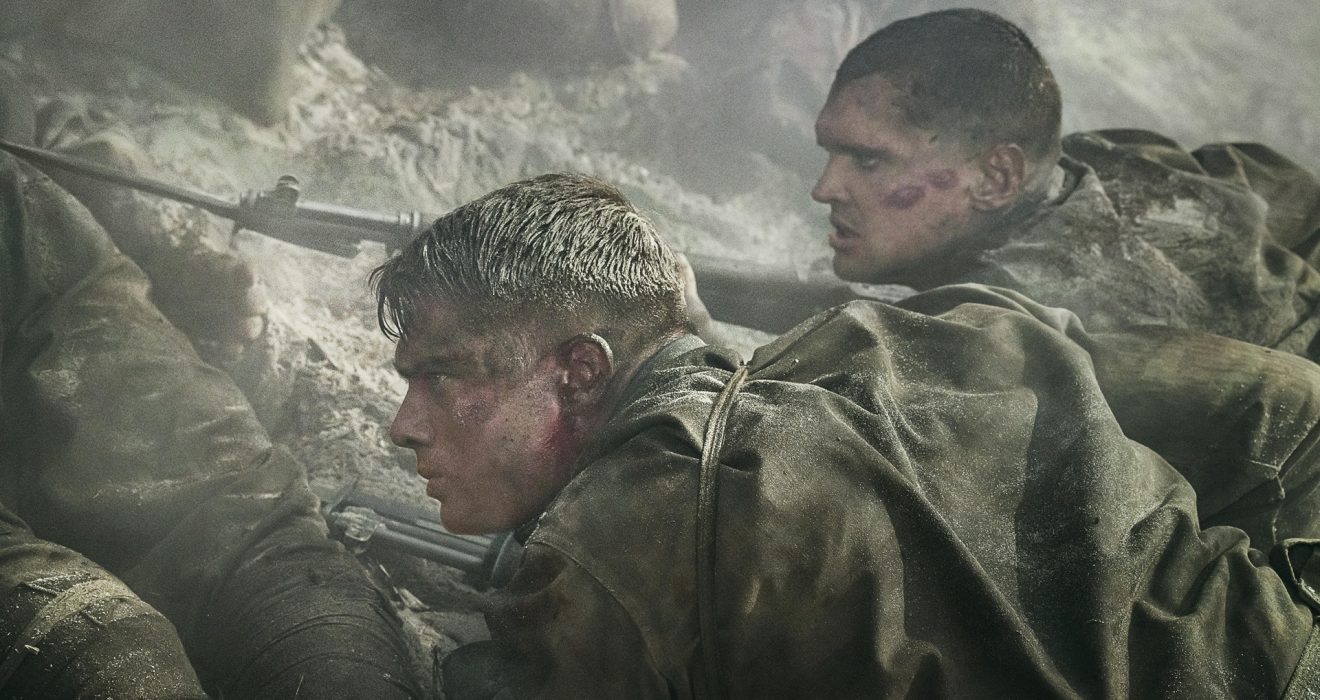
Indeed, war is hell. They arrive on the shores of Japan with gunfire, explosions, and dead bodies surrounding them before they even reach the beach. The chaotic editing slows only to highlight shouted orders or nightmarish expressions of pain. As the battle goes on and on with characters grabbing weapons and advancing over corpses, the sinking feeling sets in about what this film wants to say about war. It’s gritty and horrific, but with so much focus on primal terror, it starts to feel more like a video game. It becomes harder to note the inhumanity of the situation with an extended scene of trying to use a flamethrower on a pillbox. I can see the flames, and I can hear the agony of Japanese soldiers burning to death. Yet I feel an emptiness to it all, for how the psychological turmoil is glazed over with adrenaline-pumping war scenes and motivating yells of “They’re dead, you’re not, keep fighting.”
A defense for this framework might be that the film isn’t so much trying to explore these characters as present an accurate account of what American soldiers experienced during World War II. This argument falls apart when you consider the historical inaccuracies. The backstories of these real-life figures, and where they were during the war, have been altered to make them fit together in this story. I could understand this change if it explored something more thoughtful through this framing, but it doesn’t. Altering Tony Butkovich’s football history and placing him in the same regiment as all four primary characters is baffling given the end result.
While the war scenes are bereft of humanity amid the kinetic chaos, the titular football game held on Christmas before the Battle of Okinawa is similarly lacking. Posed as a morale booster after witnessing so much death (and apparently a bad Bob Hope show), the soldiers are pushed to blow off some steam with a familiar game. Rather than question the game’s importance during the war or how their approach has changed in this setting, the conversation immediately shifts to football strategies and trash talk. When the game finally arrives over an hour into the movie, it’s edited less like a defining moment of joy for these battered soldiers and more like the volleyball sequence from Top Gun. It’s a montage of football plays and cheers with some Christmas music placed on top. There’s never a chance to get invested in the game itself, as Berg’s direction treats us only to the highlights you’d catch on the post-game show.
After that unsatisfying game, the story returns to war with the Battle of Okinawa, this time not even bothering with any build-up to the event. The film throws us right into the violence of people getting shot, stabbed, and burned, laced with terrified Japanese civilians who would rather kill themselves than be taken prisoner. The portrayal of the Japanese in this film is as confusing as how the film treats war. The film doesn’t shy away from focusing on the footage of terrified and brutalized Japanese soldiers and civilians, but it also doesn’t portray them as anything more than the enemy, with racial slurs so casually spewed without much questioning or pushback.
Maybe the one time a soldier reconsiders the dehumanization of the Japanese is when one of the central four rejects an offer to buy the teeth and skulls of slain Japanese soldiers. I’m not expecting one of the central soldiers to give a rant about racism, but the ephemeral nature of how the film treats this ugly aspect of war is maddeningly vacuous. One soldier tries to calm down a terrified Japanese civilian on the battlefield by saying he’s not going to hurt her and that he is going to be a parent as well. This terrified woman, unable to translate English, tearfully detonates a bomb that obliterates herself and chunks of the soldier. Will the soldiers who witnessed such a sight question this inhumanity? Or will it remain bottled up for the moment to survive and the rest of their lives to live with it? It seems to be the latter, as the film leans into a quasi-jingoistic aesthetic that doesn’t hide the horrors of war but serves up little more than shock and awe.
The Mosquito Bowl features many scenes of war and football, but is more content to coast on the vibes of combat and contact sports. Perhaps the most unorthodox inclusion is the many cuts to a shot of Earth from above, teasing the coming of an atomic bomb that will end the conflict in Japan, culminating in the underwhelming cut to archival footage of the bomb exploding. Slathered with quick edits of old footage and an obligatory “thank you for your service” prologue, the whole film smells like a book report written by a reluctant student who chose the topic because they’re really into playing Call of Duty and Madden. The message intended might be that war is bad, but check out this sick shot of a Japanese tank being blown up! Oh, and also racism is bad, a lot of people died during World War II, and we should celebrate veterans. Go Wisconsin! U.S.A.! D minus.