
“Faces of Death” (2026) Review
Director: Daniel Goldhaber Screenwriter: Isa Mazzei, Daniel Goldhaber Cast: Barbie Ferreira, Dacre Montgomery, Josie Totah, Aaron Holliday, Jermaine Fowler, Charli XCX Distributor: Independent Film Company Running Time: 97 min. MPAA: R
At some point amid the onslaught of remakes, there has been mention of a compromise in the target. “Why don’t studios just remake bad movies instead of good ones?” Of course, studios won’t do that for notoriety, but there is an appeal to interrogating movies that were more infamous than famous.
Case in point, Faces of Death, a horror movie more shocking for its extra-gross and disturbingly astute gore, branded as the nastiest of the video nasties. This remake by director Daniel Goldhaber doesn’t merely reiterate the anthology’s depiction of gruesome scenes of destroyed bodies, but rather questions the obsession with the movie itself. By focusing more on the disturbing qualities that come with being desensitized to violence, the film becomes more of a fascinating exploration than the original Faces of Death only hints at if you tilt your head and squint between all the blood and guts.
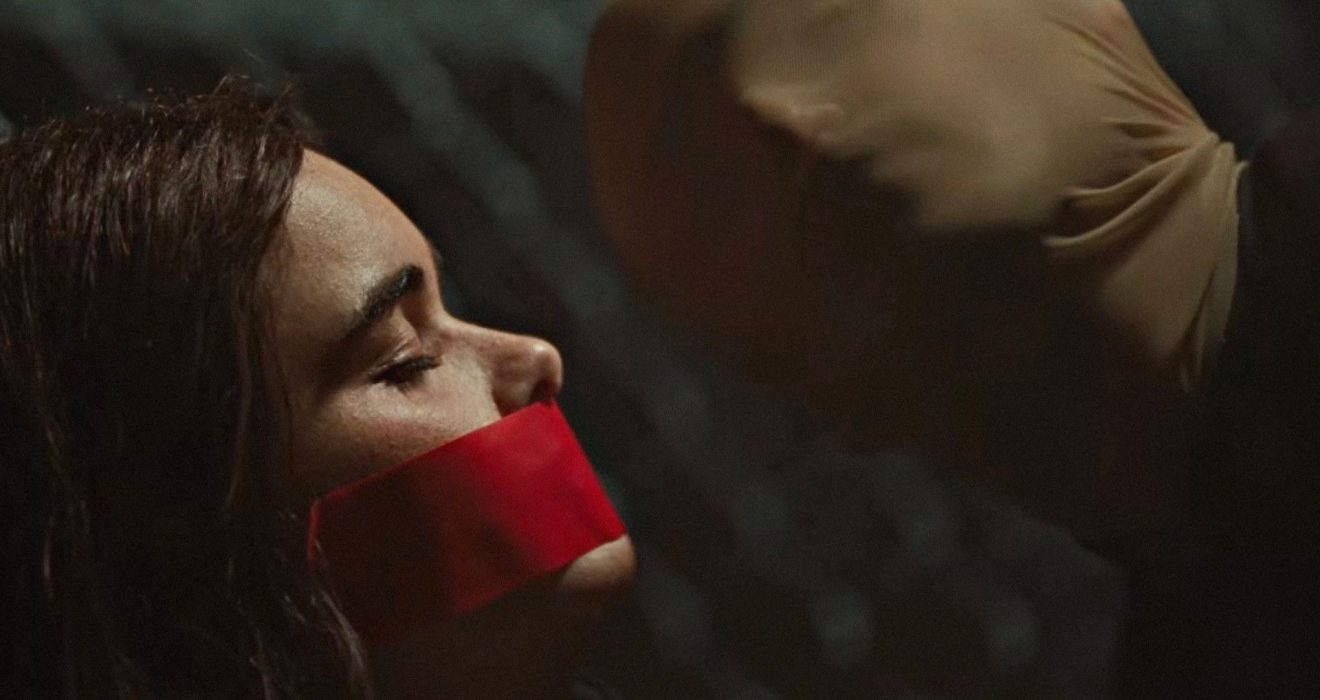
The framing of this story is compelling, with Margot Romero (Barbie Ferreira) as a content moderator for a social media video site. It’s her job to sort through the many videos uploaded a day and determine what is and isn’t suitable for the platform. Scenes of explicit sex and real-world violence are struck down without much thought, given how much vulgarity Margot witnesses. But then a video staging torture comes up, and it looks far too real. The voice-over sounds old, as though it were pulled from an old movie. She might have to do some research before eventually discovering that somebody is replicating the movie Faces of Death.
There’s a morbid fascination that Margot can’t ignore, despite how much she’s told to let it go by her boss, Josh (Jermaine Fowler). This isn’t just because Margot has a dark history with social media that ultimately caused the loss of a friend. There’s an acknowledgment that messed-up videos of violence are too good to ban from a social media platform. Somebody like Margot, who is struggling to keep her mental state together, is not content to watch her co-workers gleefully gobble up horror you’re less likely to find on Shudder and more likely on a dark web depository of real brutality. Even with her horror-savvy roommate Ryan (Aaron Holliday) trying to calm her fears, something isn’t right. Somebody must be torturing people to death and uploading these videos.
Of course, to make this story more compelling, the culprit is indeed a disturbed serial killer, taking the form of the online-obsessed Arthur (Dacre Montgomery). Although he’s a nasty individual who stalks figures on social media and news media for his viral videos of mutilation, he also knows how to play the game. Somebody this obsessed knows how to cover his tracks and weaponize the lack of evidence against people as flawed as Margot. It will make foiling his operations more complicated than merely tracking him down or going to the police. That cunning nature also makes Arthur a far more intriguing villain than his predictable ambitions to become a social media sensation and to bring horror movies to life.
There’s still the lingering problem of this movie trying to make all the pieces fit, which still has a jarring effect. In the same way that the source material became obsessed with nailing the right shade of blood and the exact number of organs, this movie tends to get lost in the mechanics rather than its psychological intrigue. Margot’s nightmares about how social media destroyed her life give her purpose, but rarely does it feel like it’s explored with much bleed-over in fighting back the violent desires of Arthur. Likewise, Arthur is given more of a creepy slasher vibe to his obsession, where there’s never a doubt that this strange dude working at a mobile phone store could be a stalker and murderer. While Arthur might have to blurt out the movie’s thesis by the final act, it does come off a little more meaningful, not feeling as tacked-on amid the assembly of terror-filled scenarios.
For the most part, Faces of Death is effective at highlighting the influence and obsession. It doesn’t feel meta-stumbling like something like the sequels to The Human Centipede, but it also doesn’t have the social gravity of something like Backrooms or Obsession. But hey, it could’ve been worse, and, thankfully, it goes beyond being a ho-hum remake that could be branded Faces of Death: The TikTok Generation.